
Upper Limb Clinic logo

Elbow conditions

Tennis elbow and golfer's elbow

Tennis elbow (lateral epicondylitis) causes pain on the outer side of the elbow. Golfer's elbow (medial epicondylitis) causes pain on the inner side. Both come from an overloaded forearm tendon, and most people who get them have never played tennis or golf. This guide explains why they happen, how they are diagnosed and how they are treated, from physiotherapy through to surgery for the few who need it.

Mr Alistair Jepson

Written by Mr Alistair Jepson
Consultant Orthopaedic Surgeon · GMC 4104128

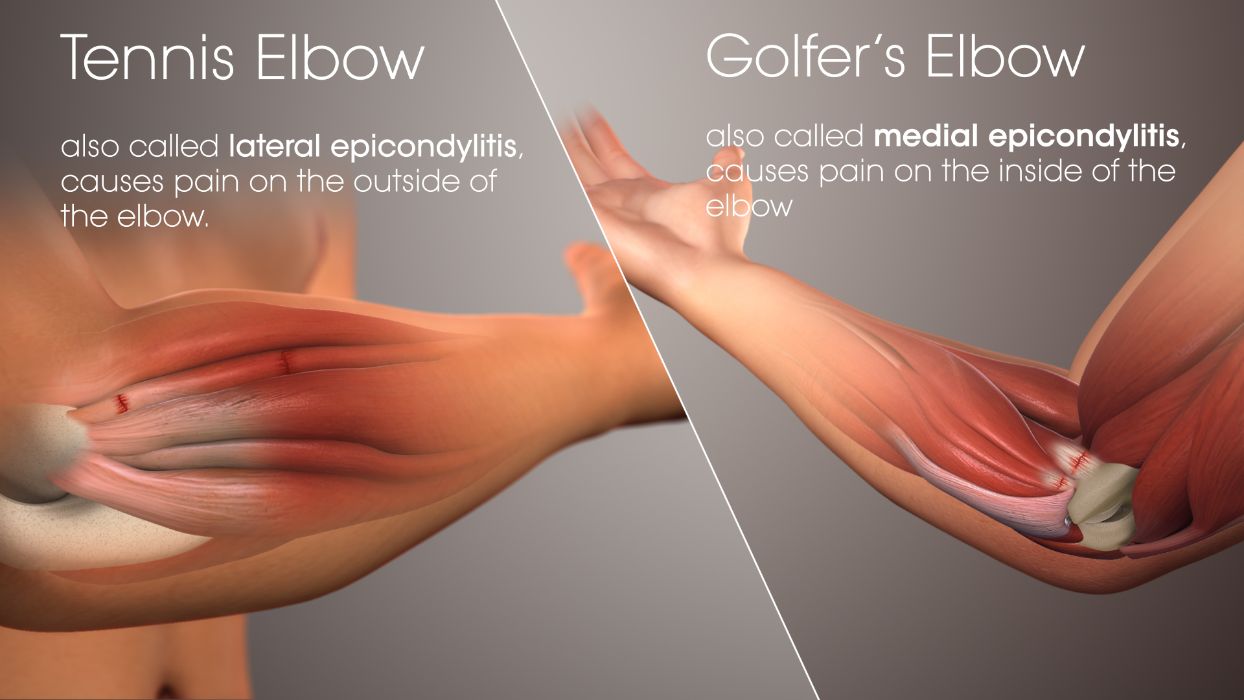
Tennis elbow on the outer side of the elbow compared with golfer's elbow on the inner side
Tennis elbow affects the outer side of the elbow, golfer's elbow the inner side.

What are tennis elbow and golfer's elbow?

The muscles of your forearm start from two shared tendons, one on each side of the elbow. The muscles that lift the wrist and straighten the fingers attach to the bony point on the outer side. The muscles that bend the wrist and fingers, and turn the palm down, attach to the bony point on the inner side.

In both conditions, part of one of these tendons becomes overloaded. Its fibres stop repairing themselves as well as they should. Doctors call this a tendinopathy: a change in the quality of the tendon, rather than a simple inflammation.

Tennis elbow affects the outer tendon. Golfer's elbow is the mirror image and affects the inner tendon. The two behave in a similar way and are treated in a similar way, but they hurt in different places.

The good news is that most cases of tennis elbow and golfer's elbow settle with time and good non-surgical care. This can take many months.

At a glance

An overload problem
The tendon has been asked to do more than it can comfortably recover from, usually over weeks or months.
Opposite sides of the elbow
Tennis elbow on the outer side, golfer's elbow on the inner side.
Usually settles without surgery
Activity changes and a steady exercise programme are the backbone of treatment for both.

Swelling at the point of the elbow, at the back, is a different problem. It is usually olecranon bursitis, which has its own guide to olecranon bursitis.

Outer elbow

Tennis elbow

Also called lateral epicondylitis or lateral elbow tendinopathy.

The muscles that lift your wrist and straighten your fingers share one tendon, the common extensor tendon. It attaches to the bony point on the outer side of the elbow, the lateral epicondyle.

In tennis elbow, the deep part of this tendon becomes overloaded and sore. Pain is felt over the outer elbow and is brought on by gripping and by lifting with the palm facing down, such as picking up a kettle, a full mug or a briefcase.

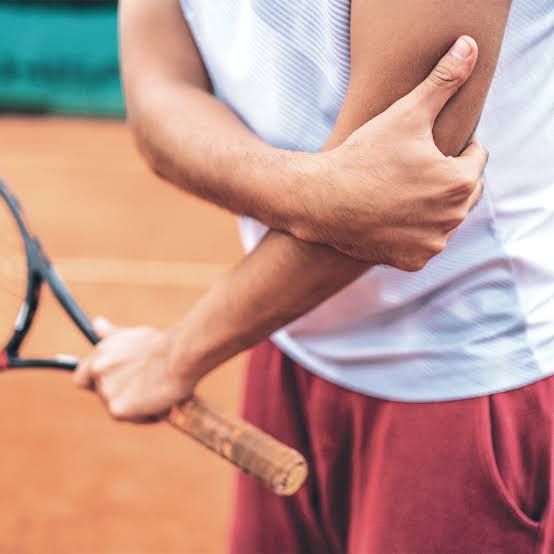
Tennis racket and the outer elbow, where tennis elbow pain is felt
Despite the name, most people with tennis elbow do not play tennis. Any repeated gripping or lifting with the wrist bent back can strain these tendons.

Typical features of tennis elbow

  • Tenderness over the bony point on the outside of the elbow
  • Pain when gripping, turning a door handle or opening a jar
  • Pain lifting with the palm down, or shaking hands firmly

Inner elbow

Golfer's elbow

Also called medial epicondylitis or medial elbow tendinopathy.

The muscles that bend your wrist and fingers, and turn your palm down, share one tendon, the common flexor-pronator tendon. It attaches to the bony point on the inner side of the elbow, the medial epicondyle.

In golfer's elbow, this tendon becomes overloaded and sore. Pain is felt over the inner elbow and is brought on by gripping, twisting the forearm and lifting with the palm facing up, such as carrying a tray or shopping bags.

The ulnar nerve

The ulnar nerve, sometimes called the "funny bone" nerve, runs just behind the inner side of the elbow. Golfer's elbow can sit alongside irritation of this nerve. If you also have tingling or numbness in your ring and little fingers, or a clumsy hand, Mr Jepson will check the nerve as well. You can read more in the cubital tunnel syndrome guide.

Symptoms of tennis elbow and golfer's elbow

Both conditions usually start gradually. Many people only notice them once everyday tasks begin to hurt. The main difference is where the pain is, and which movements bring it on.

Outer elbow

Tennis elbow

Where it hurts
Over the bony point on the outside of the elbow, often sore to touch, with an ache that can spread down the back of the forearm.
Movements that bring it on
Gripping, turning a door handle, opening a jar, using tools, lifting a kettle with the palm facing down and shaking hands firmly.
Other features
Weak grip, and stiffness or pain after resting the arm.

Inner elbow

Golfer's elbow

Where it hurts
Over the bony point on the inside of the elbow, often sore to touch, with an ache that can spread down the front of the forearm.
Movements that bring it on
Gripping, twisting the forearm, bending the wrist against resistance and lifting with the palm facing up, such as carrying bags or a tray.
Other features
Weak grip. Tingling in the ring and little fingers suggests the ulnar nerve is also involved.

What causes them?

Tennis elbow and golfer's elbow are overload problems. They develop when a tendon is asked to do more than it can comfortably recover from, often over weeks or months.

Repetitive gripping and wrist use

Repeated gripping, twisting and wrist movements are the usual triggers. Examples include DIY, gardening, carrying heavy bags and long hours at a keyboard and mouse.

Work

Manual jobs that involve tools, lifting or repeated forearm movements, such as building, plumbing, hairdressing or factory work, can overload either tendon.

Racquet and golf sports

Tennis, squash, badminton and golf can cause them, especially with a sudden increase in play or a change in technique or equipment.

Age

Both are most common between the 30s and 50s, when tendons become less able to cope with sudden increases in load.

A change in activity

A new job, a house move or a weekend of heavy work can be enough to tip an already busy tendon into pain.

Often nothing to do with sport

Despite their names, most people with tennis elbow have never played tennis, and most people with golfer's elbow do not play golf.

How tennis elbow and golfer's elbow are diagnosed

The diagnosis is usually clear from talking and examining. Scans are used when something does not fit, or when symptoms are not settling as expected.

  1. Your consultation

    Mr Jepson asks where the pain is, how it started, what makes it worse and how it affects your work, hobbies and sleep.

  2. Examination

    For tennis elbow, he checks for tenderness on the outer side and pain when you lift your wrist or middle finger against resistance. For golfer's elbow, he checks the inner side and pain when you bend your wrist or turn your palm down against resistance. He also examines your neck, the ulnar nerve and the elbow joint.

  3. Scans only when needed

    An ultrasound or MRI scan can show the state of the tendon, and an X-ray can look at the joint. These help rule out other causes, such as arthritis or nerve irritation.

To find out what each scan involves and why it might be suggested, read the guide to imaging and scans.

Non-surgical treatment

Most people with tennis elbow or golfer's elbow get better without an operation. The aim is to calm the tendon down, then gradually build up its strength so it can cope with everyday life again.

Relative rest and activity changes

Complete rest is rarely needed. Instead, ease off the tasks that clearly provoke the pain and break up long spells of repetitive work. With tennis elbow, gripping with the palm facing up can help; with golfer's elbow, palm down is often easier.

Physiotherapy and loading exercises

A structured programme of progressive tendon-loading exercises is the backbone of treatment for both conditions. Loading is increased steadily over weeks so the tendon adapts and strengthens.

Straps and braces

A forearm strap worn just below the elbow, or a wrist splint, can take some strain off the tendon during the day. Some people find this makes daily tasks easier.

Simple pain relief

Regular paracetamol, or an anti-inflammatory gel or tablet if it is safe for you, can ease pain so you can keep up your exercises. Your pharmacist or GP can advise.

The limited role of injections

A steroid injection may ease pain in the short term, but it does not repair the tendon, symptoms can return and repeated injections may weaken it. For that reason steroid is used sparingly. Other injections, sometimes given under ultrasound guidance so the needle is placed accurately, may be discussed when symptoms are slow to settle. Mr Jepson will talk through whether any injection is likely to help you.

For more on how guided injections are done, read the imaging and scans guide.

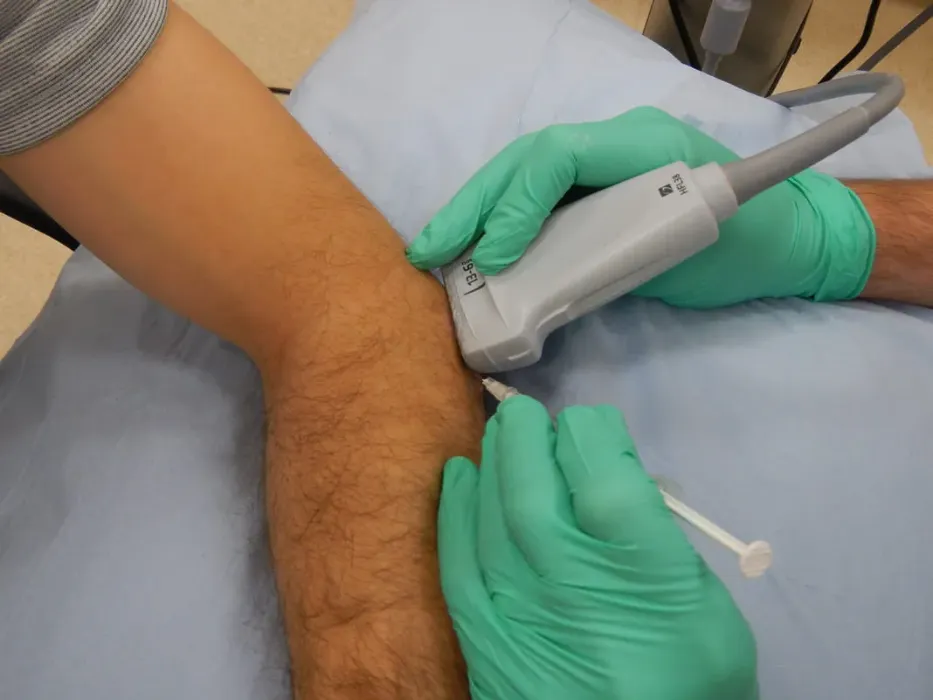
Ultrasound-guided injection into the outer elbow for tennis elbow
Ultrasound lets the injection be placed precisely at the affected tendon.

Eccentric exercises

Eccentric exercises slowly lengthen a forearm tendon while it is carrying a load. This gentle, controlled work encourages the tendon to remodel and become stronger over time.

They are one of the most useful treatments for tennis elbow and golfer's elbow, and you can do them at home with very little equipment.
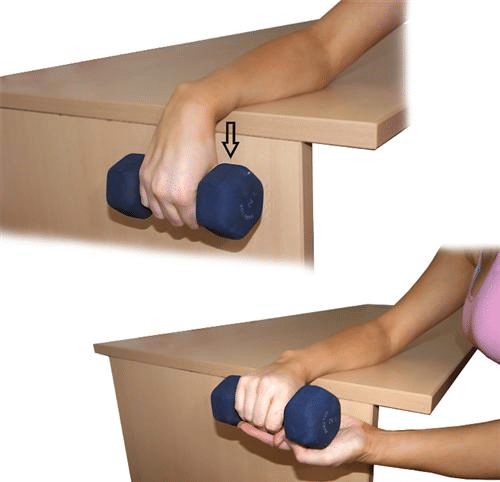
Eccentric wrist exercises for tennis elbow
Eccentric exercises: raise the wrist with your other hand, then lower it slowly on its own.

Golfer's elbow version

Do the same exercise with your palm facing up. Lift the wrist up with your other hand, then slowly lower it down. This works the tendon on the inner side of the elbow.

How to do them (tennis elbow)

  1. Sit with your forearm supported on a table, palm facing down, with your wrist and hand over the edge.
  2. Hold a light weight, for example a small bottle of water or a 0.5 to 1 kg weight.
  3. Use your other hand to lift the wrist up into the raised position.
  4. Take the helping hand away, then slowly lower the wrist down over about 3 to 5 seconds.
  5. Repeat 15 times, for 3 sets, once or twice a day.
  6. Increase the weight gradually as the exercise becomes easier.

Good to know

  • Mild discomfort during the exercise is acceptable. Stop and seek advice if the pain is sharp or lingers afterwards.
  • Keep your elbow straight and your forearm supported throughout.
  • Progress steadily and keep going for several weeks. Tendons respond slowly, so consistency matters more than effort.
  • A physiotherapist or hand therapist can check your technique and adjust the programme for you.

Printable exercise sheet

Print these steps to keep beside you while you exercise. If you would like a printed copy of the full exercise programme, ask the practice team when you call or at your appointment.

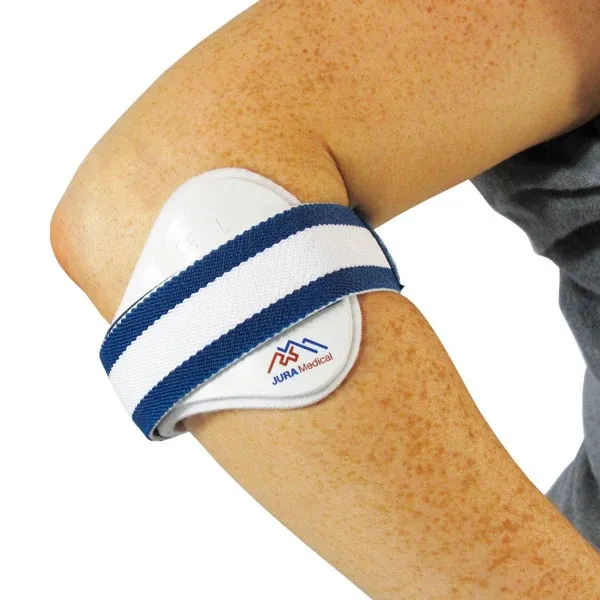
Epicondylar clasp (elbow strap)

An epicondylar clasp, also called a counterforce strap or brace, is worn around the upper forearm, a few centimetres below the elbow. It spreads the pull of the forearm muscles away from the sore tendon and can ease pain during gripping and lifting.

For tennis elbow, the clasp sits on the upper forearm, roughly two to three finger-widths below the bony point on the outside of the elbow. For golfer's elbow, a similar strap can be positioned to sit over the muscles on the inner side. It goes over the forearm muscles, not on the joint itself.

It presses gently on the muscle, so some of the muscle's pull is taken at the clasp instead of at the sore tendon where it attaches to the bone. This eases pain when you grip and lift.

Using it well

  • Wear it during the activities that bring on your pain, not in bed.
  • It should feel firm but not tight. If your hand tingles or goes numb, loosen it.
  • It eases symptoms while the tendon settles, and works best alongside a stretching and strengthening programme.
Epicondylar clasp worn on the upper forearm
An epicondylar clasp sits on the muscle just below the elbow, not over the painful bony point.
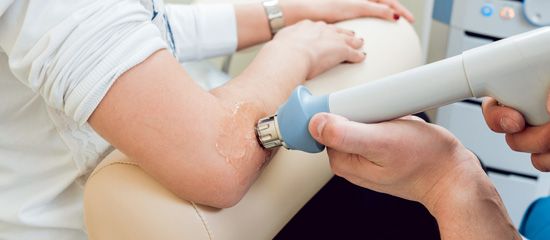
Shockwave therapy being given to the elbow for tennis elbow
Shockwave is given through the skin over the sore tendon, with no needle and no wound.

Shockwave therapy (ESWT)

Extracorporeal shockwave therapy (ESWT) passes pulses of sound energy through the skin to the painful tendon, using a handheld probe and gel. The aim is to stimulate the tendon's own healing in an area that has stopped repairing itself.

It is usually given as a short course of sessions, about a week apart, and needs no anaesthetic or wound. It can feel uncomfortable during treatment. It may be considered for tennis elbow that has not settled with exercises, and Mr Jepson can discuss whether it suits you.

Tennis elbow exercises to try at home

This video shows gentle stretching and strengthening exercises for the forearm muscles, which are a key part of treating tennis elbow. The exercises are best done little and often.

Ease off and seek advice if the pain becomes sharp or keeps getting worse. A physiotherapist or hand therapist can tailor the exercises to you.

Mr Jepson works closely with hand therapists and physiotherapists who know these exercise programmes well. You can find out about them on the About page.

Surgery for tennis elbow and golfer's elbow

Surgery is never the first step, and only a minority of people need it.

Elbow after tennis elbow surgery
Tennis elbow surgery is usually a day-case operation on the outer side of the elbow.

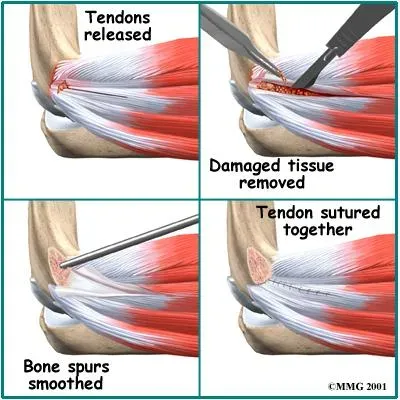
A small minority of people still have troublesome pain despite several months of good non-surgical treatment. For them, an operation on the damaged tendon origin may be an option. It is usually done as a day case, under a general or regional anaesthetic.

Outer elbow

Tennis elbow release

The damaged part of the common extensor tendon is released or debrided (the unhealthy tissue removed) from the outer elbow, so the healthy tendon can heal.

Inner elbow

Golfer's elbow release

The unhealthy part of the flexor-pronator tendon is debrided from the inner elbow. The ulnar nerve lies close by and is carefully protected throughout. If it is also irritated, Mr Jepson may discuss treating it at the same time.

Mr Jepson will talk the operation through with you carefully. He will explain what it involves, its risks, the recovery it needs, and whether it is likely to help in your particular case.

When surgery may be discussed

  • Pain that persists despite several months of well-supervised physiotherapy
  • Symptoms that still affect your work, sleep or daily life
  • Other causes of elbow pain have been ruled out

To see what happens on the day of your operation, from pre-assessment and fasting to the anaesthetic and going home, read the day of surgery guide.

Recovery and getting back to activity

Whether or not you have surgery, tendons recover slowly. Patience and a steady build-up matter more than rushing. Your own plan will be tailored to you.

The first weeks

After surgery, a sling or support may be used briefly for comfort. You keep the wound clean and dry, and begin gentle movement of the elbow, wrist and fingers early, as advised.

Rebuilding strength

Physiotherapy gradually reintroduces loading exercises over weeks to months. Grip and forearm strength are rebuilt step by step, guided by how the elbow responds.

Work and sport

Desk-based work usually resumes sooner than heavy manual work, racquet sports or golf. Full recovery can take several months.

For practical advice on slings, wound care, pain relief and follow-up after an operation, read the aftercare guide.

Common questions

If your question is not answered here, call the practice or send an enquiry. The team will be happy to help.

Do I need surgery for tennis elbow or golfer's elbow?

Usually not. Most people improve with activity changes, an exercise programme and time. Surgery is only discussed when symptoms persist despite several months of good non-surgical care and other causes have been ruled out.

Do I have to play tennis or golf to get them?

No. Most people with tennis elbow do not play tennis, and most people with golfer's elbow do not play golf. Any activity involving repeated gripping or wrist movement can overload the tendon.

Can I keep playing sport?

Often yes, at a level that does not clearly worsen the pain. You may need to cut back for a while, then build up gradually. A coach can help with technique or equipment, such as grip size, and a physiotherapist can guide your return.

How long does it take to settle?

Tendons recover slowly, so both conditions can take many months to settle, even with good treatment. Seeing a specialist can help if your elbow is not improving or is affecting your work.

Should I rest my arm completely?

Usually not. Tendons need the right amount of load to recover. The aim is to reduce the activities that clearly aggravate the pain, while keeping the arm moving and gradually strengthening it.

Will a steroid injection cure it?

A steroid injection can ease pain for a while, but it does not repair the tendon and symptoms can come back. Because repeated injections may weaken the tendon, they are used sparingly and alongside an exercise programme.

Do I need a scan?

Often not. An ultrasound or MRI scan is helpful when the diagnosis is uncertain, when symptoms are not settling as expected, or when surgery is being considered.

Can I have tennis elbow and golfer's elbow at the same time?

Yes, though it is less common. Some people have pain on both sides of the same elbow, or in both arms, particularly with heavy manual work. Both are treated in a similar way, and your exercise programme can cover both tendons.

Can I have a printed copy of the exercises?

Yes. Use the Print exercise sheet button in the eccentric exercises panel to print the steps at home, or ask the practice team for a printed copy of the full exercise programme.

Where does Mr Jepson see patients?

Mr Jepson sees private patients at Circle Three Shires Hospital in Northampton and Woodland Hospital in Kettering. Addresses and directions are on the clinic locations page, and you can read about his background on the About page.

How do I arrange a consultation?

Call the practice on 01604 633730 or email enquiries@upperlimb.co.uk. You can also send an enquiry through the contact page, and the practice team will come back to you.

Talk to the practice about your shoulder, elbow, hand or wrist

Call to arrange a consultation, book online for Circle Three Shires Hospital in Northampton, or send a short email and the practice team will come back to you.

Read independent patient reviews on Doctify (opens in a new tab), iWantGreatCare (opens in a new tab) or Google reviews (opens in a new tab)

© 2026 Mr Alistair Jepson · Powered by Carebit