
Wrist condition guide
Scaphoid fractures
A wrist that feels "sprained" after a fall onto an outstretched hand can hide a break in the scaphoid, a small bone at the base of the thumb. These fractures are easy to miss and can heal slowly, so a painful wrist after a fall is worth having checked.

Written by Mr Alistair Jepson
Consultant Orthopaedic Surgeon · GMC 4104128
What is the scaphoid?
The scaphoid is a small, curved bone on the thumb side of the wrist. Its name comes from the Greek word for a boat, which describes its shape well.
The wrist is made of eight small carpal bones arranged in two rows. The scaphoid is the only one that bridges both rows, linking them together like a strut. That makes it important for a stable, strong wrist, and it is also why it takes the force when you land on an outstretched hand.
It is the wrist bone that breaks most often, usually across its narrow middle, known as the waist.
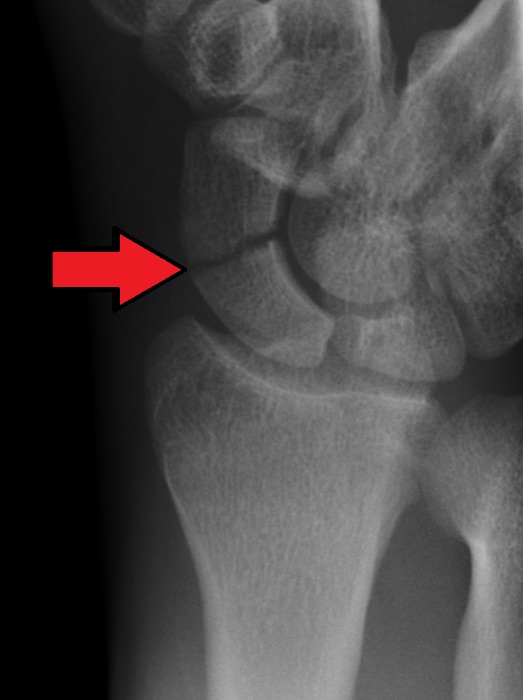
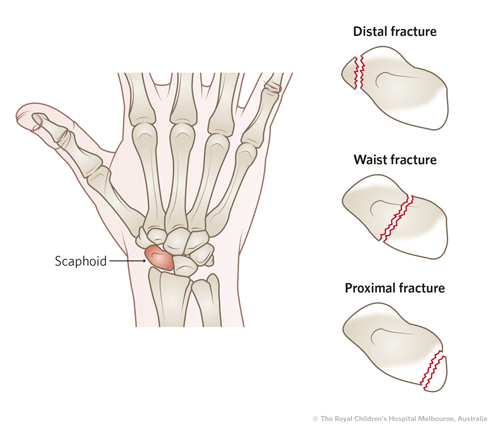
Types of scaphoid fracture
Surgeons describe a scaphoid fracture by where along the bone it occurs, because the position of the break has a big effect on how well it heals.
-
Distal pole
The end nearest the thumb. Fractures here usually heal well.
-
Waist
The narrow middle of the bone and the most common place for it to break.
-
Proximal pole
The end nearest the forearm. Fractures here are the slowest to heal.
Fractures are also described as undisplaced or displaced. In a displaced fracture the pieces of bone have moved apart, and these are more likely to need surgery to hold them in the right position while they heal.
Symptoms
Most scaphoid fractures happen after a fall onto an outstretched hand, during sport, cycling, skiing or a trip at home. The injury often feels like a sprain, and many people carry on with their day, which is why scaphoid fractures are often seen late.
-
Snuffbox tenderness
Pain when pressing the small hollow at the base of the thumb, known as the anatomical snuffbox.
-
Swelling
Puffiness on the thumb side of the wrist, sometimes with bruising, which can be mild.
-
Pain on gripping
Aching when you grip, pinch, turn a key or lean on the hand to push up from a chair.
-
A sprain that lingers
Wrist pain that seems to settle, then keeps returning with use over the following weeks.
Why a scaphoid fracture matters
The scaphoid has an unusual blood supply. Much of its blood enters at the far end, near the thumb, and then travels back through the bone towards the forearm.
When the bone breaks, the part nearest the forearm (the proximal pole) can lose some of that supply. Fractures in this area heal more slowly and are more likely to fail to join, called non-union. Occasionally part of the bone loses its blood supply altogether, called avascular necrosis.
A scaphoid that does not heal changes how the wrist moves, and over years this can wear the joint and lead to wrist arthritis. This is the main reason scaphoid fractures are taken seriously and followed up until healing is confirmed. Most are picked up and heal well with the right treatment.
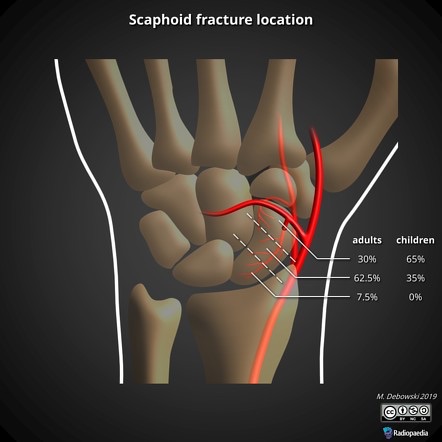
A fragile, one-way blood supply
Most bones receive blood from several directions. The scaphoid is different: most of its blood enters at the end nearest the thumb and then flows backwards through the bone to reach the end nearest the forearm.
A fracture across the bone can cut that route, leaving the proximal fragment, the piece nearest the forearm, short of blood. Bone needs a good blood supply to knit, which is why these fractures can be slow to heal, why some fail to join (non-union) and why, occasionally, the proximal fragment dies back (avascular necrosis).
It is also why early diagnosis and protecting the wrist from the start matter so much. Keeping the fracture still in a splint, cast or with a screw gives the blood supply the best chance to reach across the break.
-
Thumb end
Distal pole
Closest to where the blood enters. Fractures here usually heal well.
-
Middle
Waist
The most common place to break. Undisplaced waist fractures often heal in a cast or splint.
-
Forearm end
Proximal pole
Furthest from the blood supply. Fractures here heal slowly and are often fixed with a screw.
How a scaphoid fracture is diagnosed
A scaphoid fracture can be invisible on X-rays taken in the first days after a fall. For that reason, a wrist that is tender over the scaphoid is often treated as a fracture, in a splint, until a scan confirms either way.
-
Examination
Mr Jepson asks how the injury happened and checks for tenderness over the snuffbox and the scaphoid itself.
-
Scaphoid X-rays
A set of dedicated scaphoid views, taken from several angles, shows most fractures clearly.
-
MRI or CT if X-rays are normal
MRI picks up hidden fractures early and also shows bone bruising and ligament injuries.
-
CT to plan and follow up
CT shows whether the pieces have moved, helps plan treatment and later confirms that the bone has healed.
Read more about each type of scan in the guide to imaging and scans for the upper limb. If you have already had X-rays or scans at another hospital, please let the practice know in good time so the images can be transferred before your appointment.
Treatment in a cast or splint
Fractures where the pieces of bone have not moved apart, especially across the waist or the thumb end, are often treated without surgery.
The wrist is held in a cast or a removable splint for several weeks while the bone knits. Fractures nearer the forearm end usually need longer. Before the cast or splint comes off for good, a repeat scan, usually CT, checks that the fracture has truly healed rather than simply stopped hurting.
What to expect
- Regular reviews in clinic while the cast or splint is on
- Keeping your fingers, elbow and shoulder moving to avoid stiffness
- A scan to confirm healing before you go back to heavy use
- Hand therapy afterwards to rebuild movement and grip
Surgical fixation
Some scaphoid fractures are best held still with surgery, so the bone can heal in the right position. Most are fixed with a small compression screw that sits entirely inside the bone, pressing the two halves together so they can knit.
The operation is usually done as a day case, under a general anaesthetic or with the arm numbed by a nerve block. Live X-ray in theatre lets Mr Jepson see the bone throughout and place the fixation exactly where it is needed. There are three ways he may fix the fracture, described below.
To see what happens on the day of your operation, from pre-assessment and fasting to the anaesthetic and going home, read the day of surgery guide.
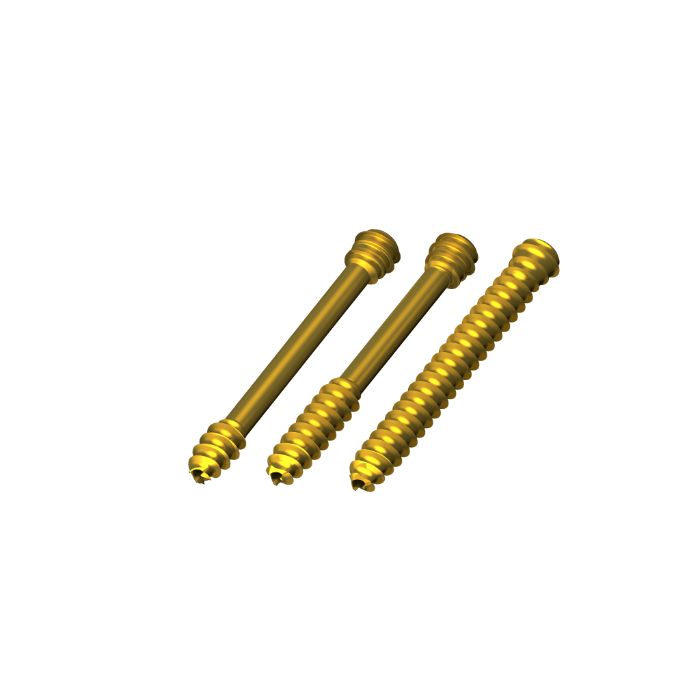
Three ways Mr Jepson fixes a scaphoid fracture
The right method depends on how recent the fracture is, whether the pieces have moved and how much of the bone is intact.
-
Percutaneous screw fixation
Used for: recent fractures, or fractures where the pieces have not moved far apart.
Through a small cut only a few millimetres long, Mr Jepson passes a fine guidewire across the fracture, using X-ray guidance to place it precisely. A headless cannulated compression screw is then passed over the wire.
The screw is buried inside the bone and squeezes the two fragments together so they can heal. It usually stays in place permanently.
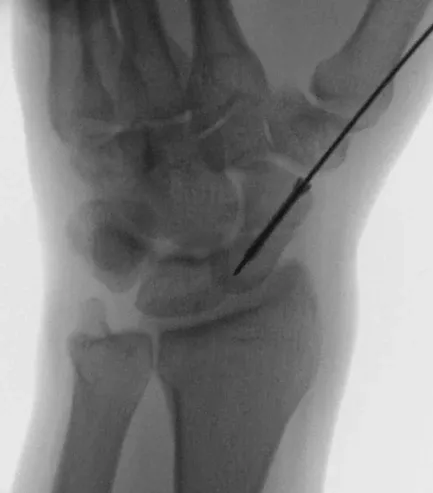
The fine guidewire is placed across the fracture first, under X-ray guidance. 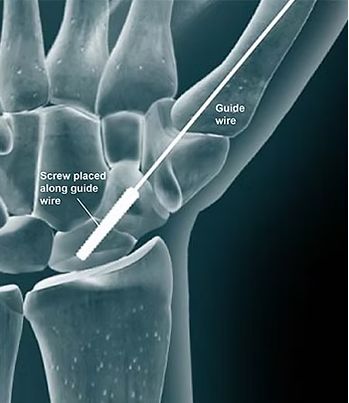
The screw then follows the wire across the fracture, holding the two pieces together. -
Open fixation with a screw, with or without bone graft
Used for: displaced fractures, or when the scaphoid has collapsed into a bent "humpback" shape.
The fracture is opened through a slightly longer incision so Mr Jepson can see the bone directly. The pieces are carefully realigned, and a compression screw holds them in their corrected position while they heal.
Where there is a gap, or the bone has collapsed, a bone graft may be added to fill the gap and restore the natural shape of the scaphoid. The graft is your own bone, taken either from the radius, the forearm bone at the wrist, or from the iliac crest, the rim of the pelvis at the hip.
About bone graft
Bone graft is also how an older fracture that has not healed is treated. The section below explains when graft is taken from the radius at the wrist and when from the iliac crest, and how healing is followed up.
When a fracture does not heal -
Plate fixation
Used for: occasionally, more complex fractures, such as those in several pieces or with bone loss, where a screw alone cannot hold the bone securely.
Through an open approach, a small, low-profile plate is fixed to the scaphoid, holding the pieces firmly together while the bone heals.
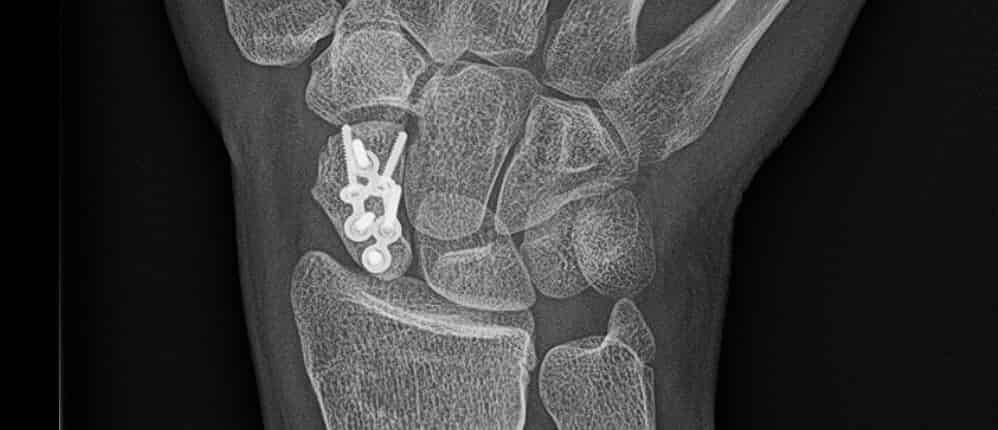
A plate is occasionally used for more complex scaphoid fractures, fixed to the bone through an open approach.
Mr Jepson will explain which option suits your fracture after reviewing your X-rays and scans with you.
When Mr Jepson may recommend surgery
-
Displaced fractures
When the pieces have moved apart and would be unlikely to heal in the right position in a cast.
-
Proximal pole fractures
Breaks near the forearm end, where the blood supply is weakest and healing is slow.
-
Getting back to work or sport sooner
For some undisplaced waist fractures, a screw allows earlier movement and less time in a cast. This is a choice Mr Jepson will talk through with you.
Consent with Concentric
Before any operation, Mr Jepson talks through the benefits, risks and alternatives with you. The practice uses Concentric, a secure digital consent system, so you can read about your operation at home, ask questions and record your decision. Your consent is confirmed again on the day.
Read more in the day of surgery guideWhen a fracture does not heal
Sometimes a scaphoid fracture does not join, either because it was not picked up at the time or because the blood supply was poor. This is called a non-union. Some people only discover it months or years later, when an X-ray is taken for ongoing wrist pain or after another injury.
A non-union is treated with surgery, using the open approach described in option 2 above. Mr Jepson removes the scar tissue from the fracture, fills the gap with a bone graft taken from the radius at the wrist or from the iliac crest at the hip, and holds the bone firmly with a screw, or occasionally a small plate when a screw alone cannot hold it securely. CT scans then follow the bone until it has healed.
Treating a non-union restores the scaphoid's role as the link between the two rows of wrist bones and protects the wrist from later arthritis. If you have an old wrist injury that never felt quite right, it is still worth having it assessed.
Where the bone graft comes from
A bone graft uses a small amount of your own bone, which contains living cells that help the scaphoid knit. It is taken from one of two places, depending on how much bone is needed and how strong it must be.
The radius at the wrist
The radius is the larger of the two forearm bones, and its lower end forms part of the wrist joint, right next to the scaphoid. Graft can often be taken through the same incision, or a short extension of it, so there is no second wound.
It is well suited to filling smaller gaps in the bone.
The iliac crest at the hip
The iliac crest is the curved rim of the pelvis that you can feel at the side of your hip. It provides a larger, stronger piece of bone, so it is used when the gap is bigger or the scaphoid has collapsed and its shape needs rebuilding.
This means a second small wound at the hip, which can feel sore for a few weeks while it settles.
Mr Jepson will explain which graft site suits your fracture before your operation, so you know what to expect afterwards.
Recovery and risks
Recovery depends on where the bone broke and how it was treated, and Mr Jepson will give you a plan for your own injury.
Getting back to normal
-
Protection. A splint or cast protects the wrist while the bone heals, for a shorter time after screw fixation than with a cast alone.
-
Hand therapy. Exercises guided by a hand therapist restore movement, then strength and grip. You can read about the hand therapists Mr Jepson works with on the About page.
-
Sport and heavy work. Contact sport, weight-bearing through the hand and heavy manual work resume once a scan confirms the bone has healed.
Possible risks
Problems are uncommon, but it is important to know about them before you decide on treatment.
-
Infection
Of the wound after surgery, usually treated with antibiotics.
-
Stiffness
Of the wrist, which usually improves with hand therapy.
-
Screw problems
Occasionally a screw irritates the joint and needs removing.
-
Delayed healing
Slow or failed healing may need further treatment, such as bone grafting.
Recovery after screw fixation, week by week
This is a typical pattern after a screw for a recent fracture. The timings are a general guide, not fixed dates: each step depends on how your own wrist is healing.
If you had open fixation or a bone graft
Fractures near the forearm end, and those treated with open fixation or a bone graft, usually need a longer period of protection before each step.
For wound care, pain relief and help with everyday tasks at home, see the aftercare guide.
-
Day of surgery to the end of week 1
The first dressing
You go home with a padded dressing and a plaster splint. Keep your hand raised above the level of your heart to ease swelling, and keep the dressing clean and dry. Gently move your fingers, elbow and shoulder several times a day so they do not stiffen.
-
Around weeks 1 to 2
Wound check and a lighter splint
At your first review the dressing comes off, the small wound is checked and any stitches are removed. The plaster is usually swapped for a lighter, removable splint, and you are shown how to look after the scar.
-
Around weeks 2 to 6
Gentle movement and light use
A hand therapist guides gentle wrist exercises. You can use the hand for light tasks such as eating, writing and typing, and desk work often resumes in this period. Wear the splint when you are out and about, and avoid lifting, pushing up from a chair or leaning on the hand.
-
Around weeks 6 to 12
A scan to check healing, then strengthening
A CT scan shows whether the bone is knitting across the fracture. Once it is, the splint is gradually left off and hand therapy moves on to strength and grip. Heavier everyday tasks are built up step by step.
-
Usually from around 3 months, once healing is confirmed
Returning to sport and heavy work
Gym work, non-contact sport and heavier manual work build up gradually. Contact sport, press-ups and other weight-bearing through the hand, and sports where a fall is likely come last, once Mr Jepson is happy the bone has healed securely.
Not every painful wrist after a fall is a scaphoid fracture. Pain on the little finger side may come from a ligament injury such as a TFCC tear, which Mr Jepson can assess at the same appointment.
Common questions
If your question is not answered here, the practice team is happy to help.
My X-ray was normal. Could I still have a scaphoid fracture?
Yes. Scaphoid fractures can be hidden on X-rays taken soon after the injury. If your wrist is still tender over the scaphoid, it is usually kept in a splint and an MRI or CT scan arranged to give a clear answer.
Will I need an operation?
Not always. Many undisplaced fractures heal in a cast or splint. Surgery is usually advised when the pieces have moved, when the break is near the forearm end of the bone, or when you would like to return to work or sport sooner and the fracture is suitable.
If you do need surgery, recent or less displaced fractures are usually fixed with a screw through a cut a few millimetres long. Displaced or collapsed fractures are opened, realigned and held with a screw, sometimes with a bone graft. A small plate is occasionally used for more complex fractures. Mr Jepson will explain which suits you once he has reviewed your scans.
How long will I be in a cast?
Usually several weeks, and longer for fractures nearer the forearm. The cast or splint comes off once a scan shows the bone has healed, so the timing depends on your own fracture rather than a fixed date.
I hurt my wrist a long time ago and it still aches. Is it too late?
No. An old scaphoid fracture that has not healed can still be treated, usually with a bone graft taken from the radius at the wrist or the iliac crest at the hip, held with a screw or occasionally a small plate. Treating it helps protect the wrist from arthritis later, so it is worth having an assessment even if the injury was months or years ago.
When can I drive, work and play sport again?
Desk work can often resume early, while driving depends on being able to control the car safely, which your insurer may also need to know about. Heavy lifting, weight-bearing through the hand and contact sport wait until a scan confirms healing. Mr Jepson will give you advice for your own job and sport.
Where does Mr Jepson see patients with wrist injuries?
Mr Jepson holds private clinics in Northampton and Kettering. You can find addresses and directions on the clinic locations page, read about his training and team on the About page, or browse other shoulder, elbow, hand and wrist conditions.
Related conditions
Other wrist and hand problems that can cause similar pain or follow a fall.
- TFCC tears and ulnar carpal impaction Pain on the little finger side of the wrist, often after a fall or twist. Read the guide
- Ganglion cysts of the wrist and hand Smooth, fluid-filled lumps on the wrist or hand, and when to treat them. Read the guide
- Thumb base (CMC) arthritis Aching at the base of the thumb when pinching, gripping or opening jars. Read the guide
- Carpal tunnel syndrome Numbness and tingling in the fingers from a squeezed nerve at the wrist. Read the guide
Talk to the practice about your shoulder, elbow, hand or wrist
Call to arrange a consultation, book online for Circle Three Shires Hospital in Northampton, or send a short email and the practice team will come back to you.
Read independent patient reviews on Doctify (opens in a new tab), iWantGreatCare (opens in a new tab) or Google reviews (opens in a new tab)