Upper Limb Clinic logo

Hand condition guide

Finger arthritis: DIP, PIP and MCP joints

Arthritis in the small joints of the fingers can cause pain, stiffness, swelling and changes in shape. These can make gripping, pinching and everyday tasks harder. This guide explains the three finger joints and how arthritis in them is assessed. It also covers the options Mr Alistair Jepson discusses with patients, from hand therapy, splints and image-guided injections to fusion, joint replacement and PIP joint denervation.

Mr Alistair Jepson

Written by Mr Alistair Jepson
Consultant Orthopaedic Surgeon · GMC 4104128

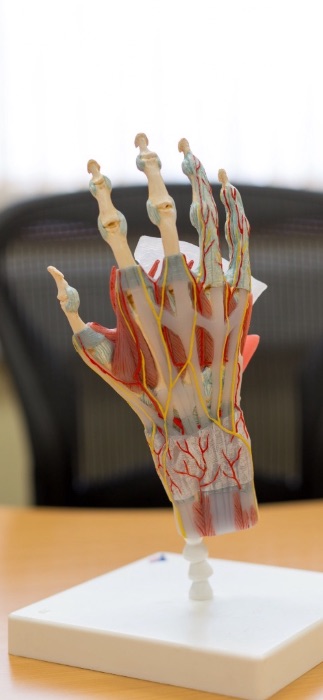
Anatomical model of the hand
Each finger has three joints that can be affected by arthritis.

The three finger joints

Each finger bends at three joints. Smooth cartilage covers the ends of the bones so they glide easily. In arthritis this cartilage wears or becomes inflamed. The joint can then become painful, stiff, swollen or unstable.

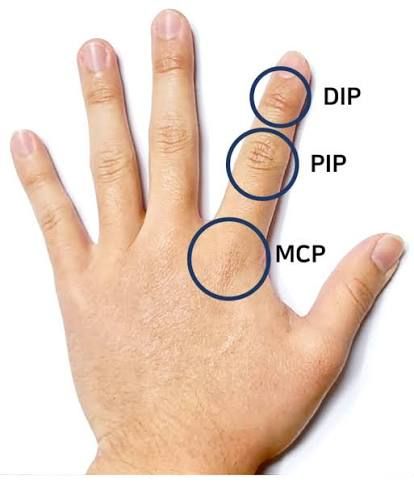
DIP joint - the end joint
The distal interphalangeal joint, nearest the fingernail. It moves the fingertip for fine pinch.
PIP joint - the middle joint
The proximal interphalangeal joint, in the middle of the finger. It provides much of the finger's bending for gripping.
MCP joint - the knuckle joint
The metacarpophalangeal joint, where the finger meets the hand. It lets the whole finger bend, straighten and spread.

Types of finger arthritis

Osteoarthritis

Wear of the joint cartilage. It most commonly affects the DIP and PIP joints and often runs in families.

Inflammatory arthritis

Conditions such as rheumatoid arthritis, where inflammation damages the joint. The MCP joints are often affected.

After an injury

An old fracture or dislocation into a joint can lead to arthritis in that joint, sometimes years later.

Arthritis at the base of the thumb behaves differently and has its own guide: thumb base (CMC) arthritis.

The three finger joints: DIP, PIP and MCP
The finger bones (phalanges) meet at the DIP and PIP joints, and the finger joins the hand at the MCP joint.

Symptoms of finger arthritis

Symptoms often come and go, with flare-ups lasting days or weeks. One finger or several may be affected. The pattern can also differ between the end, middle and knuckle joints.

Pain

An ache in the joint, often worse with gripping, pinching or after heavy use, and sometimes at night.

Stiffness and swelling

Fingers that feel stiff, especially first thing in the morning, with puffy or warm joints during a flare.

Bony lumps

Firm nodes over the joint: Heberden's nodes at the DIP joint and Bouchard's nodes at the PIP joint.

Mucous cysts near the nail

Small fluid-filled cysts beside an arthritic DIP joint, sometimes causing a groove in the nail. They are a type of ganglion cyst.

Fingers drifting sideways

A finger may angle or twist at a worn joint. In inflammatory arthritis the fingers can drift at the knuckles.

Weaker pinch and grip

Difficulty with jars, keys, buttons and writing, because a painful or unstable joint cannot take load.

How finger arthritis is diagnosed

Most finger arthritis can be diagnosed at a single consultation. The aim is to understand which joints are causing the problem, how they affect your hand and what matters most to you.

  1. Consultation

    Mr Jepson asks about your symptoms, your work, hobbies and daily tasks, any previous injuries, and any family history of arthritis.

  2. Examination

    Each joint is checked for movement, stability, swelling, tenderness and alignment. Your grip and pinch are also checked.

  3. X-ray

    X-rays show joint space narrowing, bony spurs and alignment, and help plan treatment for each joint. More on X-rays and other scans is on the imaging and scans page.

  4. Blood tests and rheumatology

    If an inflammatory arthritis such as rheumatoid arthritis is suspected, blood tests are arranged. Mr Jepson works with a rheumatologist so the underlying condition is treated alongside your hand.

Hand therapy, splints and everyday care

Hand therapy is the foundation of treatment for finger arthritis, and many people manage well without surgery. A hand therapist shows you how to protect painful joints and keep your fingers moving and strong. They will also help you decide whether a splint would help.

These measures do not reverse arthritis. They can ease pain, reduce flare-ups and help you keep doing the things that matter to you.

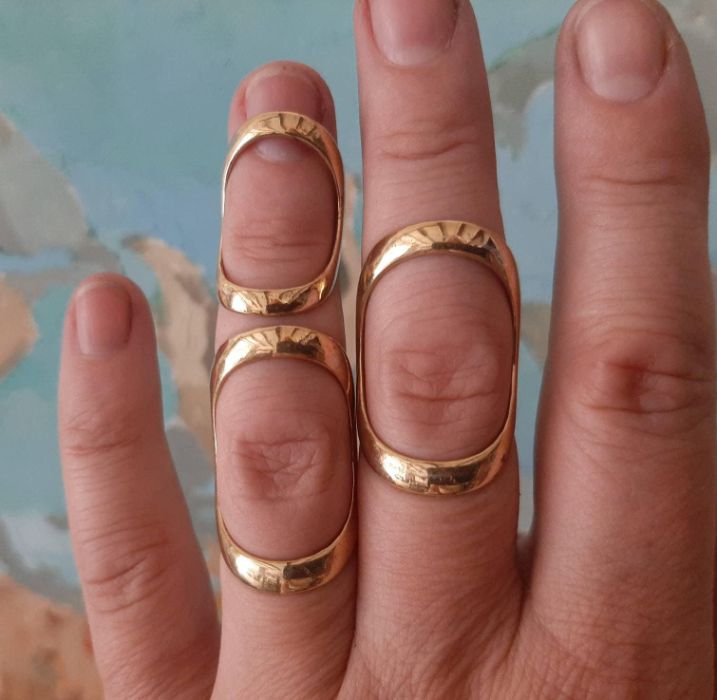
Jewellery-style ring splints for finger arthritis
Ring-style splints look like jewellery and can support a finger joint discreetly through the day.

Joint protection

Simple changes reduce strain on sore joints, such as thicker-handled tools, jar openers and spreading load across the whole hand.

Exercises

Gentle exercises, tailored by your hand therapist, keep each joint moving and maintain grip and pinch strength.

Splints where helpful

A small splint can rest a painful joint or support one that is drifting, during activity or at night. Splints are optional and not everyone needs one. See how to wear a finger splint.

Simple pain relief

Regular simple painkillers or anti-inflammatory gels can help during flare-ups. Check with your GP or pharmacist that they suit you.

Splints for hand osteoarthritis
A well-fitted finger splint rests a painful joint and should hold it comfortably, without pressing or rubbing.

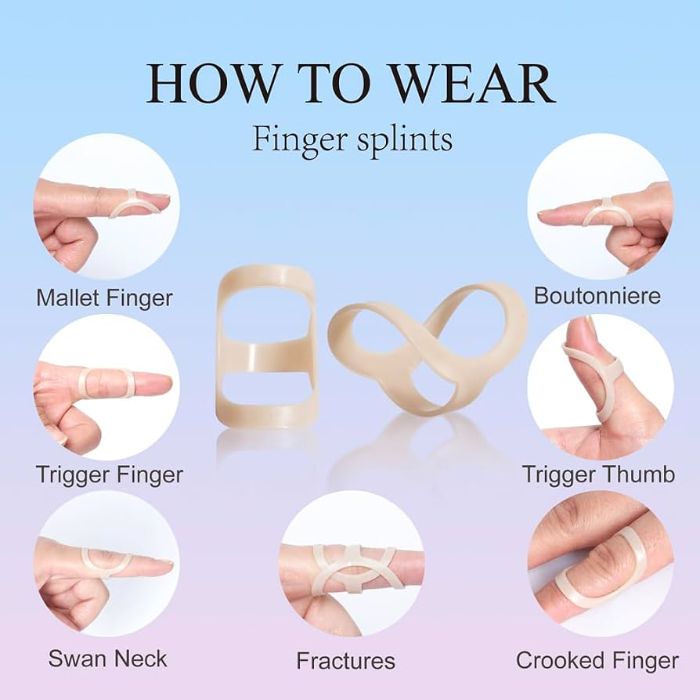
How to wear a finger splint

Your hand therapist will make or fit your splint and show you how to wear it. As a general guide:

  1. Wear it when advised

    This is often during heavier tasks, or at night to rest the joint. Your therapist will tell you how long to wear it each day.

  2. Position the finger

    Slide the splint on so the painful joint sits snugly inside it, in the position your therapist set. Leave the other joints free unless you have been told otherwise.

  3. Fasten it snugly, not tightly

    Straps or tape should hold the splint in place without digging in. You should be able to slide a fingertip under the strap.

  4. Check your skin

    Each time you take the splint off, look for red marks or rubbing. Any marks should fade soon afterwards.

  5. Take it off to wash and exercise

    Keep the skin and the splint clean and dry. Keep doing the movement exercises your therapist gave you, so the joints do not stiffen.

Take the splint off and contact your hand therapist or the practice if your finger becomes numb, tingly, pale or more painful. Do the same if the splint rubs or no longer fits.

Image-guided steroid injections

The finger joints are very small, so injections are given using ultrasound or X-ray guidance. This lets the steroid be placed accurately inside the joint rather than in the tissues around it.

A steroid injection can calm inflammation and ease pain, which may make hand therapy and daily tasks more comfortable. It does not repair worn cartilage. How much it helps, and for how long, varies from person to person. If an injection helps, it can be repeated, usually several months apart.

Find out how guided injections are carried out on the imaging and scans page.

What to expect

  • A short appointment. The skin is cleaned and the joint is located on the screen.
  • A fine needle and a small amount of steroid, often with local anaesthetic.
  • The finger may ache for a day or two before any benefit is felt.
  • Mr Jepson will explain possible side effects, such as a temporary flare, skin thinning or raised blood sugar in people with diabetes.

DIP joint fusion

When the end joint stays painful despite non-surgical care, fusion is the main surgical treatment. The worn joint surfaces are removed and the two bones are held together so they heal as one.

What is done

A small incision is made over the joint. The bones are then fixed straight or slightly bent, using a small screw or fine wires.

What you gain

A stable, pain-free fingertip that can push firmly against the thumb for pinch. A finger that had drifted is also straighter.

What changes

The end joint no longer bends. Because the middle and knuckle joints keep moving, most people find this loss is well tolerated.

If a mucous cyst sits beside the joint, it can usually be dealt with during the same operation.

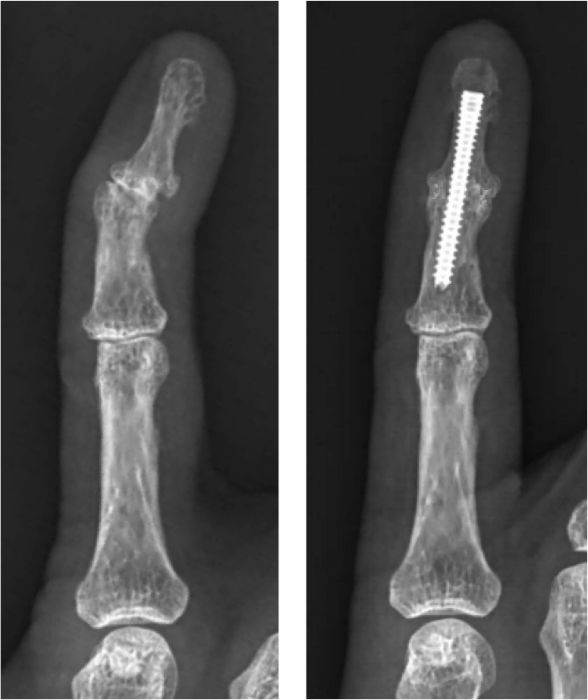
X-ray of a fused DIP joint
This X-ray shows a fingertip (DIP) joint held straight while the bones heal together.

Surgical options for the PIP joint

The middle joint matters a great deal for grip. The choice of operation depends on which finger is affected, how stable and well aligned the joint is, and how much movement it still has.

Artificial PIP finger joint replacement
An artificial PIP joint replaces the worn surfaces of the middle finger joint, aiming to ease pain while keeping movement for grip.

Main option

PIP joint replacement

The worn joint surfaces are replaced with a small implant to relieve pain while keeping movement. This can be a flexible Silastic (silicone) implant. Replacement is often favoured in the middle, ring and little fingers, where bending matters for grip and side-to-side forces are lower.

If unstable or deformed

PIP joint fusion

The joint is fixed at an angle chosen for that finger. Fusion suits a joint that is unstable, badly damaged or deformed. It is often preferred in the index finger, which needs strong side-to-side pinch against the thumb.

If movement is good but painful

PIP joint denervation

This is for a painful joint that still has a good range of movement. The small nerve branches that carry pain from the joint are divided. Movement is kept, nothing is implanted and recovery is quick. Replacement or fusion remain open later if needed.

PIP joint replacement

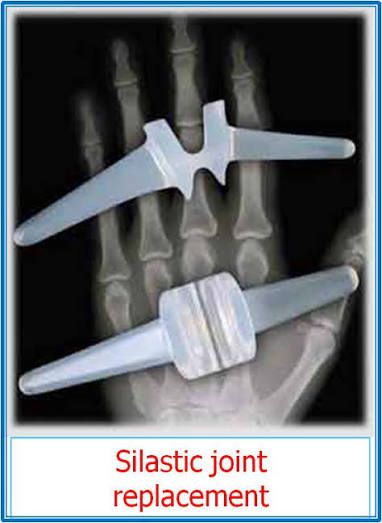
Silastic (silicone) PIP joint replacement

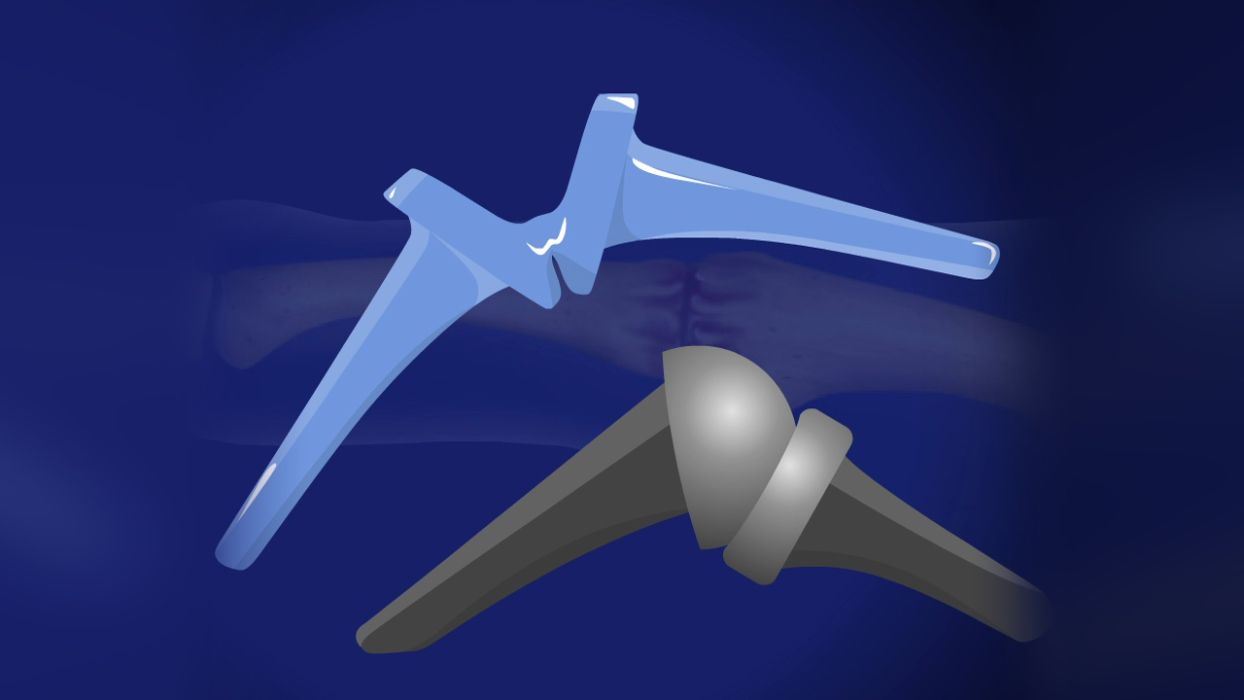
A Silastic implant is a one-piece, flexible implant made of medical-grade silicone. It has a stem at each end and a hinge in the middle that bends as the finger moves. Each stem sits in the hollow centre of the bone on either side of the joint.

The implant is not glued or fixed to the bone. Instead, it acts as a flexible spacer. Over the following weeks the body forms a firm layer of tissue around it, which helps to support the new joint. Silicone implants have been used in the finger joints for many decades.

The aim
To relieve pain and keep a comfortable, useful arc of bending. It does not restore a completely normal joint.
Who it suits
A joint with reasonable bone and stable ligaments, most often in the middle, ring and little fingers.
Over time
A silicone implant can wear or break over the years. If that happens, it can usually be replaced, or the joint can be fused. See how long a finger joint replacement lasts.
Choosing an implant
Silicone is one of several implant designs. Mr Jepson will explain which suits your finger and your hand.
Silicone PIP joint replacement
A flexible silicone spacer replaces the worn middle finger joint to keep some movement while easing pain.
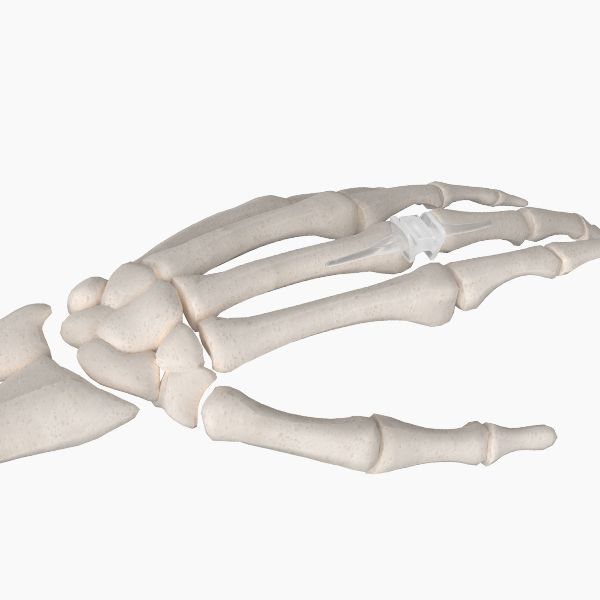
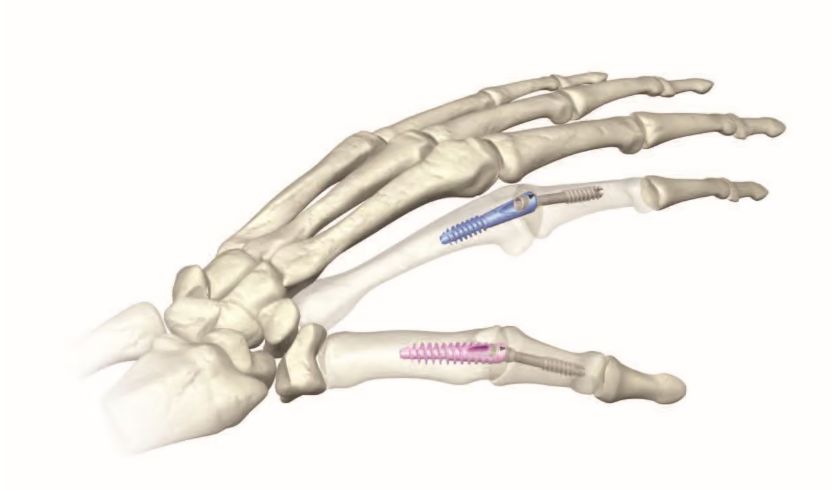
PIP joint replacement
A PIP joint replacement sits in the middle joint of the finger, with a stem in the bone on each side.

Surgical options for the MCP joint

The knuckle joints let the whole finger bend and spread, so surgery here usually aims to keep that movement. Knuckle arthritis is often linked to inflammatory arthritis, so treatment is planned with your rheumatology care in mind.

MCP knuckle joint replacement
An MCP joint replacement takes the place of a worn knuckle joint, aiming to ease pain while keeping the finger able to bend and straighten.

Main option

MCP joint replacement

The damaged knuckle joint is replaced with an implant, usually a flexible silicone (Silastic) implant of the same one-piece design. This relieves pain and keeps knuckle movement. Where the fingers have drifted, the soft tissues around the joint can be rebalanced at the same time to help straighten them.

If unstable

MCP joint fusion

Sometimes a knuckle joint is too unstable to support a replacement. Fusing it at a functional angle then gives a stable, pain-free base for the finger, at the cost of knuckle movement.

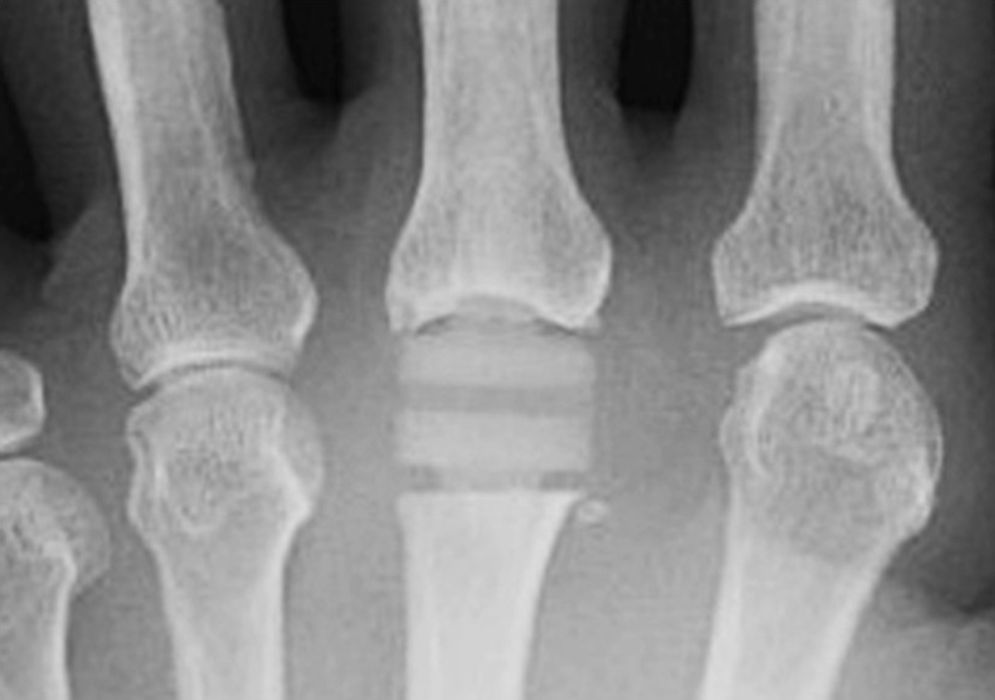
X-ray of an MCP knuckle joint fusion
An X-ray of a fused knuckle (MCP) joint, where the bones are fixed in position so they heal together as one.

Comparing the options joint by joint

A quick summary of the surgical options for each joint. Hand therapy, splints and guided injections are tried first for all three.

DIP - end joint

Main options
Fusion is the main operation.
When fusion is used
For a painful, worn or unstable end joint. It is the standard surgical treatment here.
What movement is kept
The end joint no longer bends. The PIP and MCP joints keep moving as before.

PIP - middle joint

Main options
Joint replacement, including Silastic (silicone) implants; denervation when movement is good; fusion.
When fusion is used
If the joint is unstable, badly damaged or deformed. Also in the index finger, where strong side pinch is needed.
What movement is kept
Replacement aims to keep a useful arc of movement. Denervation keeps the movement you already have. Fusion fixes the joint at a set angle.

MCP - knuckle joint

Main options
Joint replacement, usually with a Silastic (silicone) implant.
When fusion is used
If the joint is unstable.
What movement is kept
Replacement aims to keep knuckle movement. Fusion fixes the knuckle at a set angle.

This is a general guide. The right choice for you depends on your joints, your hand and your goals. Mr Jepson will talk through the options at your consultation.

Recovery at a glance

Finger joint operations are usually done as a day case under a regional block, which numbs the arm. You go home the same day. What happens at the hospital is explained in your day of surgery.

  1. After fusion

    The finger is protected in a splint for several weeks until the bones join, which is checked on X-ray. Use of the hand then builds up gradually, with hand therapy if needed.

  2. After replacement

    Movement starts early under the guidance of a hand therapist. Over the following weeks, a splint protects the new joint between exercises.

  3. After denervation

    Nothing is implanted and the bone is not operated on. The finger can usually be moved straight away, with a return to light use within days.

These timings are typical. Your own recovery will depend on the joint, the operation and your work and activities. Wound care, swelling, pain relief and when to get in touch are covered in aftercare.

Common questions

General answers to questions patients often ask about finger arthritis. Your own situation will be discussed at your consultation.

Will I need surgery for finger arthritis?

Most people do not. Many people manage well with hand therapy, joint protection, splints where helpful, simple pain relief and guided injections. Surgery is considered when pain continues despite these measures and affects daily life. It is also considered when a joint becomes unstable or badly deformed.

Which finger joints can be replaced?

The PIP (middle) and MCP (knuckle) joints can be replaced, often with a flexible silicone implant. This is explained in Silastic (silicone) PIP joint replacement. The DIP (end) joint is small and needs to be firm for pinch, so fusion is the usual operation there. See the joint-by-joint comparison above.

How long does a finger joint replacement last?

There is no fixed lifespan. How long an implant lasts depends on the joint, the type of implant, the quality of the bone and ligaments around it, and how heavily the hand is used.

Silicone implants are flexible spacers, so over the years they can wear, tear or break. This does not always cause problems, because the firm tissue that forms around the implant often continues to support the joint. Some people notice the pain returning, the joint becoming looser or the finger starting to drift again.

If an implant wears out, it can usually be replaced with a new one, or the joint can be fused to give a stable, pain-free finger. Avoiding repeated heavy gripping and forceful twisting, as your hand therapist advises, helps protect the implant.

Mr Jepson will review your finger after surgery, with X-rays when needed. If new pain, swelling or a change in the shape of the finger develops later, please contact the practice for a review.


Why would a joint be fused rather than replaced?

A replacement keeps movement, but it relies on the ligaments and bone around it to stay stable. Fusion gives a strong, stable, pain-free joint. It suits joints that are unstable, badly damaged or deformed, and the DIP joint. It also suits the index finger PIP joint, which takes strong side-to-side pressure when you pinch against the thumb. The trade-off is that the fused joint no longer bends.

What is PIP joint denervation, and who does it suit?

Denervation divides the small nerve branches that carry pain signals from the joint. The nerves that give feeling to the finger are left intact. It suits people whose PIP joint is painful but still stable, with a good range of movement. It does not change the joint itself and nothing is implanted. Recovery is quick, and replacement or fusion can still be done later if needed.

Do steroid injections help finger arthritis?

They can ease pain and inflammation for a time, particularly during a flare. They do not repair cartilage, and the benefit varies between people. Injections into the small finger joints are given with ultrasound or X-ray guidance, usually several months apart. More detail is in the guided injections section above and on the imaging and scans page.

How do I arrange a consultation?

Call the practice on 01604 633730, or send an enquiry through the contact page. Mr Jepson sees patients at clinics in Northampton and Kettering. You can read more about Mr Jepson, or browse other hand and upper limb conditions. If you have previous X-rays or scan reports, please bring them with you.

Talk to the practice about your shoulder, elbow, hand or wrist

Call to arrange a consultation, book online for Circle Three Shires Hospital in Northampton, or send a short email and the practice team will come back to you.

Read independent patient reviews on Doctify (opens in a new tab), iWantGreatCare (opens in a new tab) or Google reviews (opens in a new tab)

© 2026 Mr Alistair Jepson · Powered by Carebit