
Adults aged about 40 to 60
Frozen shoulder most often appears in middle age. It is uncommon in younger adults unless there has been an injury or operation.
Shoulder conditions
Adhesive capsulitis, explained plainly
Frozen shoulder can be painful, frustrating and slow to settle, and it often disturbs sleep. This guide from Mr Alistair Jepson, Consultant Orthopaedic Surgeon, explains what is happening inside the shoulder, who tends to get it, how it changes over time and the treatments that can help, including hydrodistension.

Written by Mr Alistair Jepson
Consultant Orthopaedic Surgeon · GMC 4104128
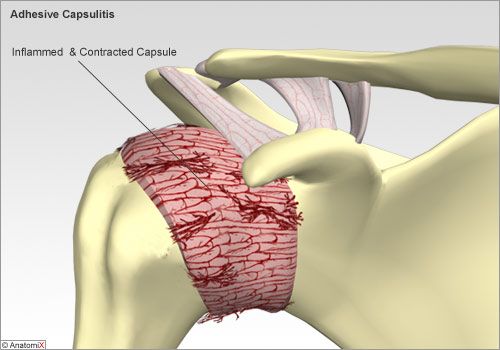
The shoulder joint sits inside a soft, flexible lining called the capsule. In frozen shoulder this capsule becomes inflamed, then thickened and tight, so there is less room for the joint to move.
The result is usually pain first, followed by stiffness. Many people notice they can no longer reach behind their back, fasten clothing or lie on the affected side. A typical sign is losing the ability to turn the arm outwards, away from the body, even when someone else tries to move it for you.
Comes on without an obvious cause. This is the most common form, and it is more likely in people with certain health conditions such as diabetes.
Develops after something else, such as a shoulder injury, an operation, or a period when the arm has been kept still.
Anyone can develop frozen shoulder, but it is noticeably more common in some groups. Knowing this helps it to be recognised early, rather than put down to something else.
Frozen shoulder most often appears in middle age. It is uncommon in younger adults unless there has been an injury or operation.
Women are affected more often than men, which is one reason hormonal change is thought to play a part.
Frozen shoulder is particularly common in women around the time of the menopause. Changing hormone levels are thought to contribute, although the exact link is still being studied.
At this stage of life, shoulder pain and poor sleep are easily put down to other things: being busy, ageing, or general aches. As a result, frozen shoulder is often overlooked for a while. If your shoulder is steadily becoming more painful and stiff, it is worth having it properly assessed.
Frozen shoulder is more common in people with both type 1 and type 2 diabetes. It is more likely to affect both shoulders, either together or one after the other, and can be more stubborn to settle.
Keeping blood sugar well controlled helps the shoulder recover. If you have diabetes, let us know at your consultation, as it affects how some treatments, particularly steroid injections, are planned.
Both an overactive and an underactive thyroid are linked with a higher chance of developing frozen shoulder.
A fall, a fracture, an operation on the shoulder or elsewhere, or a spell with the arm in a sling can all trigger secondary frozen shoulder.
Frozen shoulder is also seen more often in people with some other conditions, including heart disease and Dupuytren's disease, a thickening of tissue in the palm of the hand. Having one of these does not mean you will develop it, but it can be a useful clue when working out the cause of shoulder pain.
Frozen shoulder usually follows a recognisable pattern. The stages overlap and vary from person to person, but the overall course is often many months, and sometimes longer.
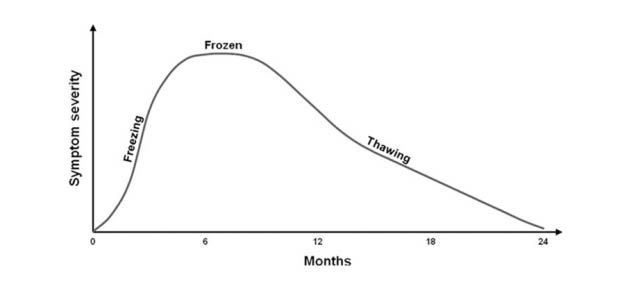
Pain builds, often aching at rest and sharp with sudden movements. Night pain is common. Movement gradually starts to become restricted.
The pain often eases, but the shoulder is now at its stiffest. Everyday tasks such as dressing, washing hair and reaching up can be difficult.
Movement slowly returns. Recovery is gradual, and some people are left with a degree of stiffness they may barely notice day to day.
Frozen shoulder is mainly diagnosed from your story and a careful examination. Scans are used to make sure nothing else is causing your symptoms.
A conversation about when the pain started, how it has changed, how it affects sleep and daily life, and any health conditions such as diabetes or thyroid disease.
Comparing how far you can move the arm yourself (active movement) with how far it can be moved for you (passive movement). In frozen shoulder both are reduced, especially turning the arm outwards.
Imaging helps rule out other causes of a painful, stiff shoulder, such as arthritis, calcific tendonitis or a rotator cuff tear. In frozen shoulder the X-ray usually looks normal.
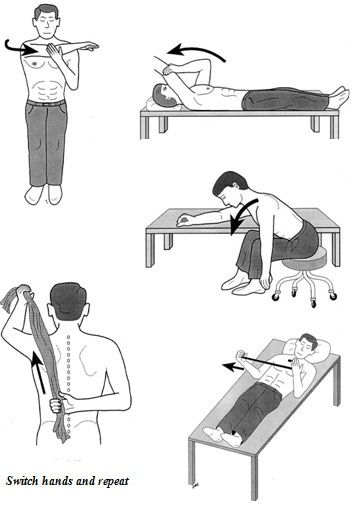
Most people are treated without an operation. The aim is to control pain, protect sleep and keep the shoulder moving while it recovers.
Simple painkillers or anti-inflammatory medicines, if they suit you, can make the painful phase more manageable and help you sleep.
During the painful stage, a steroid injection into the shoulder can calm the inflammation in the capsule and ease pain considerably.
Regular, gentle stretches within comfort, often guided by a physiotherapist. Forcing the shoulder through severe pain tends to make things worse.
Practical tips for work, driving, dressing and sleeping positions, so you can stay as active as possible without aggravating the shoulder.
Treatment in focus
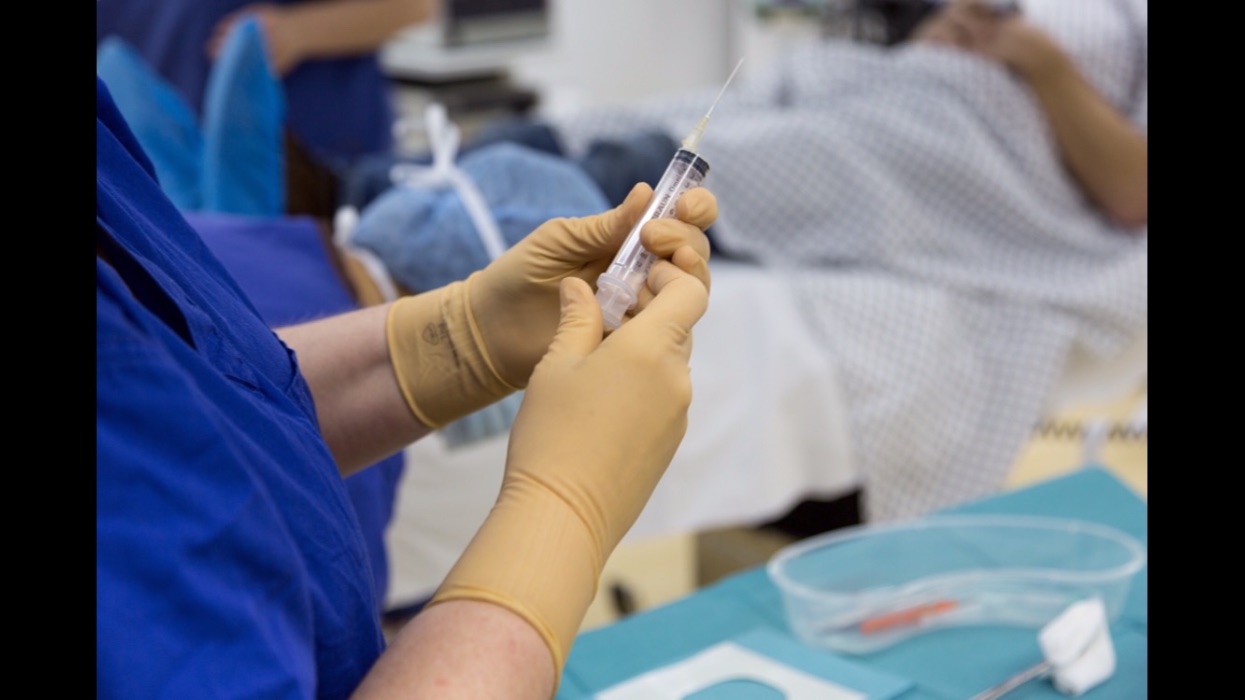
Hydrodistension is an image-guided injection into the shoulder joint. Local anaesthetic and steroid are given together with a larger volume of sterile saline (salt water), which gently stretches the tight joint capsule from the inside.
Each part has a job: the local anaesthetic numbs the joint, the steroid calms the inflammation in the capsule, and the saline does the stretching. For many people with a stiff frozen shoulder, it offers a way to regain movement without an operation.
Ultrasound or X-ray guidance means the needle is placed accurately inside the joint. You can read more about how image-guided injections work in the imaging and scans guide.
People with a painful, stiff frozen shoulder that has not settled with physiotherapy or a simple steroid injection.
It is not usually the first treatment offered. Your consultation will confirm whether your shoulder is likely to benefit, and whether anything else needs to be ruled out first.
Hydrodistension is a short, straightforward procedure. Knowing what to expect at each step makes the day easier and helps you get the most from it.
This matters most: start your stretching exercises and physiotherapy within a few days. Moving the shoulder regularly is what keeps the stretch gained by the injection.
Hydrodistension is one step in your recovery, not the whole of it. Here is an honest picture of how it may go and what happens next.
Many patients notice that the shoulder moves more easily and that night pain eases.
Results vary from person to person. How well the shoulder does depends a great deal on keeping up the stretching exercises and physiotherapy afterwards.
Hydrodistension can sometimes be repeated.
If stiffness persists, keyhole surgery may be considered: arthroscopic capsular release and manipulation, which releases the tight capsule directly.
You will usually have a review with Mr Jepson some weeks after the procedure.
He will check your movement, pain and progress with physiotherapy, and talk through the next steps with you.
When stiffness does not improve despite injections, hydrodistension and physiotherapy, keyhole surgery can release the tight capsule directly.
This keyhole surgery is usually considered when hydrodistension has not helped enough.
Through small incisions, a camera and fine instruments are used to carefully divide the thickened parts of the capsule. The shoulder is then gently moved through its range to free any remaining tightness. This is done under anaesthetic, usually as a day case or with a short stay.
Early physiotherapy, starting very soon after the operation, is what protects the movement gained in theatre, just as it does after hydrodistension.
To see what happens on the day of your operation, from pre-assessment and fasting to the anaesthetic and going home, read the day of surgery guide.
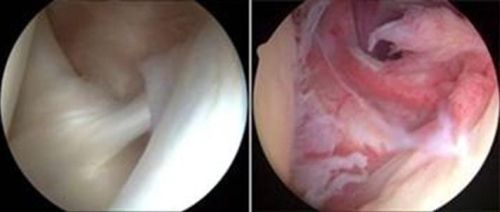
Frozen shoulder often improves gradually by itself, but this usually takes many months and sometimes longer, and some people are left with a little stiffness. Treatment aims to ease pain, help you sleep and speed up recovery of movement, rather than simply waiting.
Local anaesthetic numbs the area first, so most people describe a feeling of pressure or fullness rather than sharp pain while the fluid goes in. The shoulder may ache for a day or two afterwards, and simple pain relief usually helps. The section on what happens before, during and after hydrodistension explains each step.
A simple steroid injection mainly calms inflammation and pain. Hydrodistension uses the same kind of medicines but adds a larger volume of sterile saline, which stretches the tight capsule as well. It is always image-guided, so the fluid goes accurately into the joint. See what hydrodistension is and who it suits.
Plan to take it easy for the rest of the day, and arrange for someone to drive you home. Gentle everyday use of the arm is encouraged, and the stretching exercises should start within a few days. Ask at your consultation how this fits with your own work and driving.
There is no fixed date. When you can drive again depends on the treatment you have had (hydrodistension or arthroscopic capsular release), whether you are asked to wear a sling, and how quickly you get active movement back. To drive safely you must be able to move your shoulder yourself, without help, and react normally in an emergency.
UK rules expect drivers to steer with both hands unless the DVLA has given specific permission otherwise. You are responsible for being in control of your vehicle at all times, and you should be able to show this if you are stopped by the police.
Do not drive while taking strong painkillers that can make you drowsy, such as opioids, or for at least 24 hours after an anaesthetic. You only need to tell the DVLA if problems affecting safe driving are likely to last more than three months after your procedure.
Before you return to driving, check with Mr Jepson, your physiotherapist and your motor insurer.
In short
Frozen shoulder is more common with diabetes, can affect both shoulders and may take longer to settle. Steroid, used in injections and usually in hydrodistension, can raise blood sugar for a few days, so you may be advised to check it more often afterwards. Good blood sugar control also supports recovery. Please mention your diabetes at your consultation.
Mr Jepson is recognised by Bupa, AXA Health, Vitality, Cigna and WPA only. Self-funding is also available. It is worth checking your cover and any authorisation with your insurer before your appointment. See the insurance information on the home page.
Call the practice on 01604 633730 or email enquiries@upperlimb.co.uk. Mr Jepson sees patients at private clinics in Northampton and Kettering; see clinic locations for details.
Other shoulder and neck problems that can cause similar pain and stiffness.
Call to arrange a consultation, book online for Circle Three Shires Hospital in Northampton, or send a short email and the practice team will come back to you.
Read independent patient reviews on Doctify (opens in a new tab), iWantGreatCare (opens in a new tab) or Google reviews (opens in a new tab)