
Pectoralis major tendon tears
A tear of the large chest muscle's tendon usually happens in a single moment, often under a heavy bar or in a tackle. When the tendon has come away from the bone completely, it is best repaired early, so a prompt assessment gives you the widest choice of treatment.

Written by Mr Alistair Jepson
Consultant Orthopaedic Surgeon · GMC 4104128
The anatomy
What is the pectoralis major?
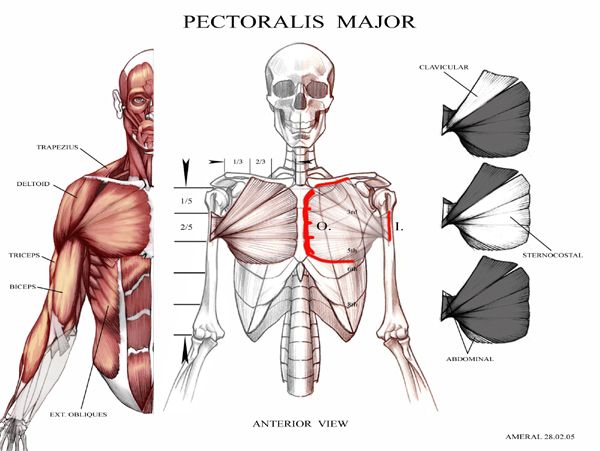
The pectoralis major is the large, fan-shaped muscle across the front of your chest. It is the main muscle you use to push, press and bring your arm across your body.
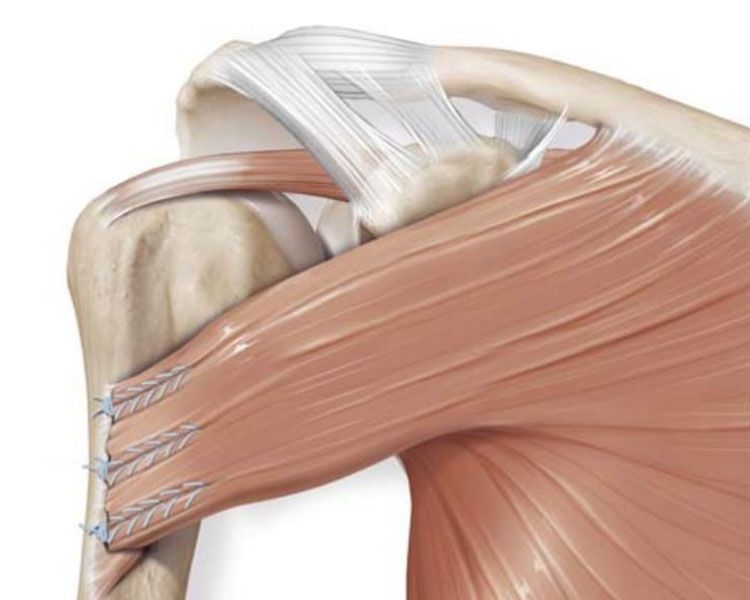
It has two parts, or heads. The upper, clavicular head starts from the collarbone, and the larger, lower sternal head starts from the breastbone and ribs. Both heads come together into a flat tendon that crosses the front of the armpit and attaches to the upper arm bone (the humerus), just below the shoulder.
Most tears happen where this tendon meets the bone. Less often the tear is where the muscle joins the tendon, or within the muscle itself, and where it happens affects how it is best treated.
Causes
How the tendon tears
These injuries are most common in active adults. The tendon usually gives way when the muscle is working hard while it is being stretched, at the moment the arm is out to the side and pulled backwards.
Heavy lifting
The classic injury is at the bottom of a heavy bench press, when the bar is lowered to the chest and the tendon is at full stretch.
Contact sport
In rugby, tackling with the arm outstretched can force it backwards against the pull of the chest muscle.
Falls and sudden loads
A fall onto an outstretched arm, or catching a heavy weight unexpectedly, can cause the same tear away from sport.
Experience with sports injuries
Mr Jepson looks after sports injuries of the shoulder and upper limb, and works with Northamptonshire County Cricket Club, Bedford Rugby Club and Oundle Rugby Club. He understands that for many patients the goal is a safe return to training and competition.
More about Mr Jepson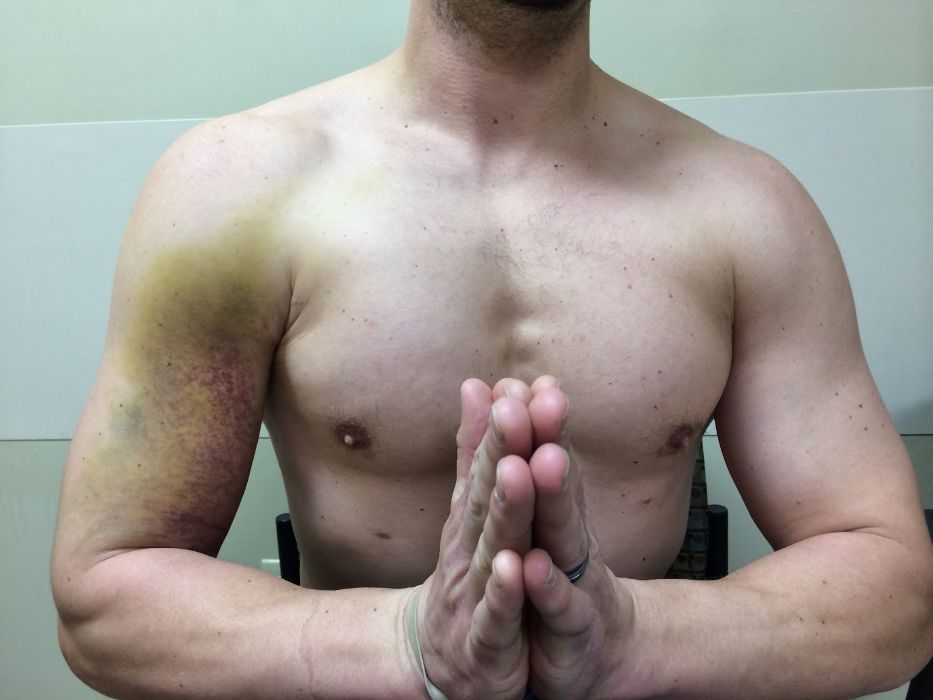
Symptoms
What you may notice
- A sudden pop or tearing feeling in the chest or the front of the armpit.
- Pain at the front of the shoulder and chest straight away.
- Bruising that spreads across the chest and into the upper arm over the next few days.
- A change in the shape of the chest, with the fold at the front of the armpit looking thinner or missing.
- Weakness when pushing, or when bringing the arm across the body.
Once the swelling settles the pain can ease quickly, which can make the injury seem less serious than it is. If you felt a pop and see these changes, it is worth having it checked.
Diagnosis
Confirming the tear
-
Examination in clinic
Mr Jepson asks how the injury happened, then looks at the shape of the chest and armpit fold and tests your strength while the muscle works.
-
MRI scan
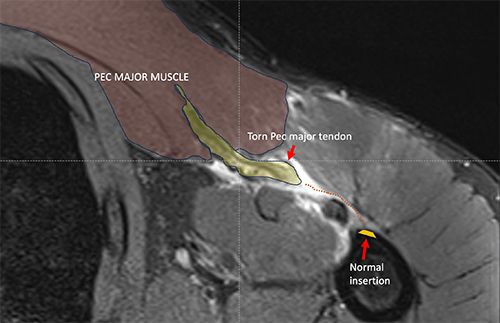
An MRI shows exactly where the tear is, whether it is partial or complete, and how far the tendon has pulled back. This is what guides the choice between repair and non-surgical treatment.
-
A plan together
The findings are talked through with you alongside your work, sport and goals, so the plan fits you.
Treatment
Treatment without surgery
Surgery is not right for every tear. Non-surgical treatment is usually recommended for:
Partial tears
Where part of the tendon is still attached to the bone and holding the muscle in place.
Tears within the muscle
Tears in the muscle itself, or where muscle meets tendon, generally heal well without a repair.
Lower-demand patients
If heavy pushing and contact sport are not part of your life, everyday function is often good without surgery.
Treatment starts with a sling for comfort and rest, with ice and pain relief while the bruising settles. Physiotherapy then restores movement first and, over the following weeks, rebuilds strength. Some loss of strength or a change in the chest's shape can remain, which is why this route suits some people better than others.
Surgery
Surgical repair of a complete tear
When the tendon has come away from the bone completely in an active person, it is usually best repaired within the first few weeks. At this stage the tendon has not pulled back far or scarred down, so it can be brought back to its normal position.
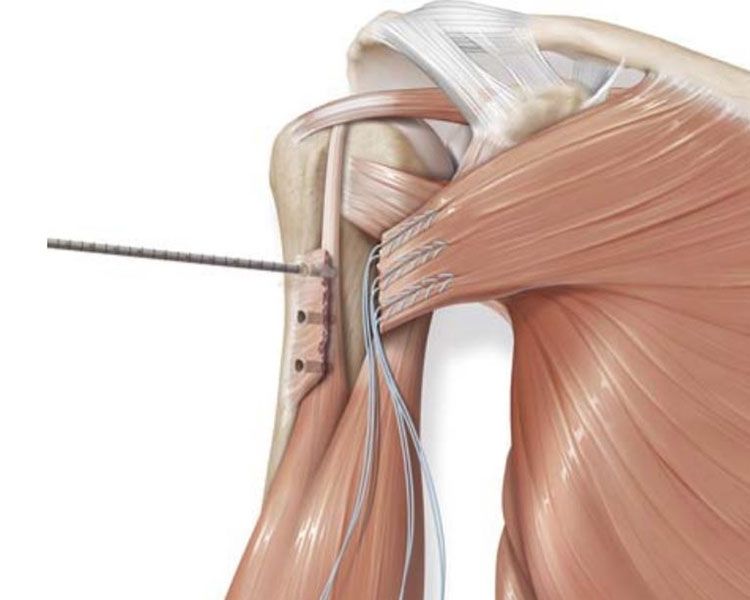
The operation is done under general anaesthetic through an incision near the front of the armpit, which keeps the scar discreet. The torn tendon is found, freed up and reattached to the upper arm bone using strong stitches and anchors or small fixation devices.
Most people go home the same day or the next morning, with the arm in a sling.
Please note: the two photographs below were taken during surgery and show the tendon being repaired.
Consent with Concentric
Before any operation, Mr Jepson talks through the benefits, risks and alternatives with you. The practice uses Concentric, a secure digital consent system, so you can read about your operation at home, ask questions and record your decision. Your consent is confirmed again on the day.
How consent fits into your day of surgeryTo see what happens on the day of your operation, from pre-assessment and fasting to the nerve block and going home, read the day of surgery guide.
Late presentation
Tears seen later on
Some people are not seen until months after the injury, sometimes because the pain settled quickly or the tear was not recognised at first. Over time the tendon pulls back and scars, and the muscle may shorten.
A late tear can still often be reconstructed. If the tendon will no longer reach the bone, it can be lengthened with a tendon graft to bridge the gap. This is a larger operation and recovery is usually slower than after an early repair.
If you have a long-standing weakness or a change in the shape of your chest after an old injury, it is still worth an assessment to talk through what may be possible.
Recovery
Recovering after a repair
Recovery is staged to protect the repair while it heals to the bone. Timings are a guide only, and your own plan is agreed with Mr Jepson and your physiotherapist.
-
Around the first six weeks
Sling and protection
The arm stays in a sling, with gentle exercises for the elbow, wrist and hand. Pushing and lifting are avoided.
-
After the sling
Restoring movement
Physiotherapy gradually brings back the shoulder's full range of movement.
-
The following months
Strengthening
Strengthening starts with light loads and builds steadily as the repair matures.
-
Several months on
Pressing and contact sport
A return to heavy pressing, such as bench press, and to contact sport is agreed with you individually.
Risks of surgery
All operations carry some risk. Mr Jepson will talk these through with you before you decide.
- Infection
- Wound healing problems
- Stiffness of the shoulder
- The tendon tearing again
- Nerve injury, which is rare
Questions
Common questions
Can't find your answer? Contact the practice or call 01604 633730.
Looking for another problem? See all shoulder, elbow, hand and wrist conditions.
How soon should I be seen after the injury?
As soon as you reasonably can. Complete tears are best repaired within the first few weeks, so an early assessment and MRI keep all the options open.
Do I need a referral from my GP?
Many insurers ask for a GP referral before they will cover the consultation, so it is worth checking with your insurer. If you are paying for yourself, the practice team can advise you when you call.
Will I always need an operation?
No. Partial tears, tears within the muscle and injuries in people who do not need heavy pushing strength are often treated with a sling and physiotherapy. Surgery is usually advised for complete tendon tears in active people.
I've already had a scan elsewhere. Should I bring it?
Yes, please let the practice know in plenty of time before your appointment, so the images can be transferred electronically and are ready for Mr Jepson to review with you.
When can I get back to the gym or rugby?
Light training returns step by step after the sling comes off. Heavy pressing and contact sport usually come several months after surgery, and the timing is agreed with you individually based on how your repair and strength progress. Read more about Mr Jepson's sports injury work.
When can I drive after pectoralis major repair?
There is no fixed date. It depends on the repair you have had, how long your arm needs to stay in a sling, and how quickly active movement and strength return. To drive safely you must be able to move your shoulder and arm yourself, without help and without putting the repair at risk, and be able to react normally in an emergency.
UK rules expect drivers to steer with both hands unless the DVLA has given specific permission otherwise. You are responsible for being in control of the car at all times, and you should be able to show this if you are stopped by the police.
Do not drive while taking strong painkillers that can make you drowsy, such as opioids, or for at least 24 hours after an anaesthetic. You only need to tell the DVLA if problems affecting safe driving are likely to last more than three months after the operation. Check with Mr Jepson, your physiotherapist and your motor insurer before you drive again.
In short
- You must not drive one-handed.
- The recommended time in your sling is the minimum before you consider driving.
- Return to driving when you can move your arm without help and react safely in an emergency.
- Telling your insurer is not always essential, but it is sensible.
Where will I be seen and treated?
Mr Jepson sees private patients in Northampton and Kettering. See the clinic locations for addresses and directions.
Related conditions
Other tendon and shoulder problems that Mr Jepson assesses and treats.
- Distal biceps tendon rupture A tendon tear at the front of the elbow, often during a heavy lift. Read the guide
- Rotator cuff tears Torn shoulder tendons causing pain and weakness lifting the arm. Read the guide
- Shoulder instability and SLAP tears Dislocations, labral and SLAP tears, and stabilisation surgery. Read the guide
- Shoulder arthritis and shoulder replacement A worn shoulder joint and the options for anatomical or reverse replacement. Read the guide
Talk to the practice about your shoulder, elbow, hand or wrist
Call to arrange a consultation, book online for Circle Three Shires Hospital in Northampton, or send a short email and the practice team will come back to you.
Read independent patient reviews on Doctify (opens in a new tab), iWantGreatCare (opens in a new tab) or Google reviews (opens in a new tab)