
Elbow condition guide
Elbow arthritis and elbow arthroscopy
A painful, stiff elbow can make everyday tasks such as eating, washing and reaching surprisingly hard. This guide explains what elbow arthritis is, how it is diagnosed, the treatments available and what to expect if Mr Jepson recommends keyhole surgery.

Written by Mr Alistair Jepson
Consultant Orthopaedic Surgeon · GMC 4104128
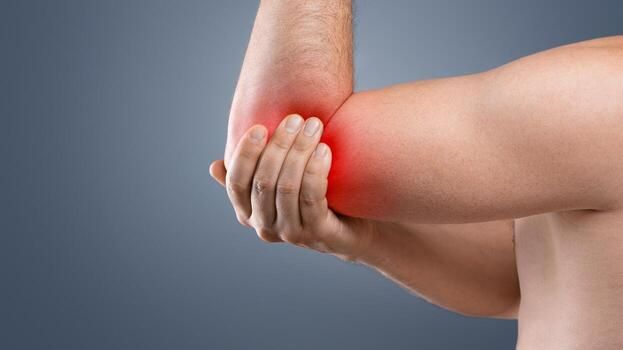
What is elbow arthritis?
Your elbow is where three bones meet: the humerus in the upper arm, and the ulna and radius in the forearm. Where these bones touch, their ends are coated in articular cartilage, a smooth, slippery layer that lets the joint glide and absorbs the forces passing through it.
A thin lining called the synovium covers the rest of the inside of the joint and produces fluid that keeps it lubricated. Strong collateral ligaments on the inner and outer sides hold the elbow steady.
The elbow makes two distinct movements. Bending and straightening happen between the humerus and the ulna, while turning the forearm so your palm faces up or down happens between the radius and the ulna. Three major nerves run very close to the joint on their way to the hand.
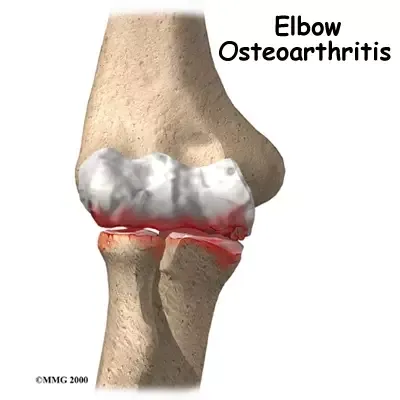
Arthritis develops when the cartilage wears thin or becomes damaged.
The joint then becomes painful and stiff. The body often responds by growing extra bone at the edges of the joint (bone spurs), and small pieces of cartilage or bone can break free and float inside the elbow as loose bodies.
Symptoms
Elbow arthritis usually comes on gradually. Common symptoms include:
- Pain, especially at the very end of bending or straightening the arm.
- Stiffness and being unable to fully straighten or fully bend the elbow.
- Catching or locking, often caused by loose fragments getting caught in the joint.
- Grating or grinding as the elbow moves.
- Swelling around the joint.
- Tingling or numbness in the ring and little fingers, if the ulnar nerve on the inner side of the elbow becomes irritated.
What causes it?
The elbow is less prone to arthritis than the hip or knee, so when it does develop there is often an identifiable reason behind it.
Wear and tear
Osteoarthritis, where cartilage gradually thins with age and use.
Previous injury
A fracture or dislocation can damage the joint surface and lead to arthritis years later.
Inflammatory arthritis
Conditions such as rheumatoid arthritis, where the joint lining becomes inflamed and damages the cartilage.
Repetitive heavy use
Years of manual work or heavy lifting place repeated strain on the elbow.
Osteochondritis dissecans
A patch of bone and cartilage loses its blood supply and loosens, seen mainly in young throwers and gymnasts.
How it is diagnosed
Mr Jepson will start by listening to how your elbow affects your daily life, then examine its movement, stability and the nerves around it. Imaging confirms the diagnosis and helps plan treatment.
-
History and examination
Where it hurts, what makes it worse, any catching or locking, and how far the elbow bends, straightens and rotates.
-
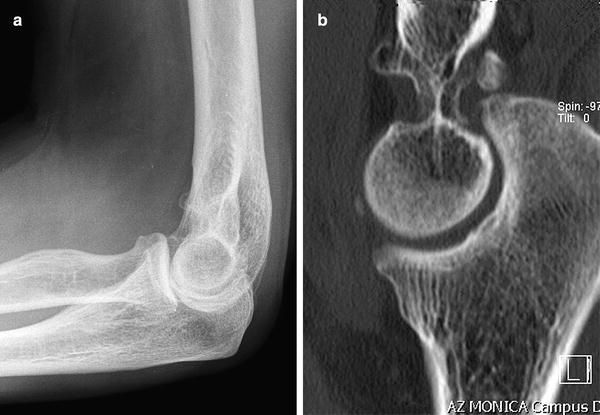
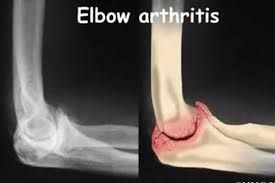
X-ray
Shows narrowing of the joint space, bone spurs and many loose bodies.
-
CT scan
Maps bone spurs and loose fragments in detail, which is especially helpful before surgery.
-
MRI scan
Shows the cartilage, ligaments and other soft tissues when more information is needed.
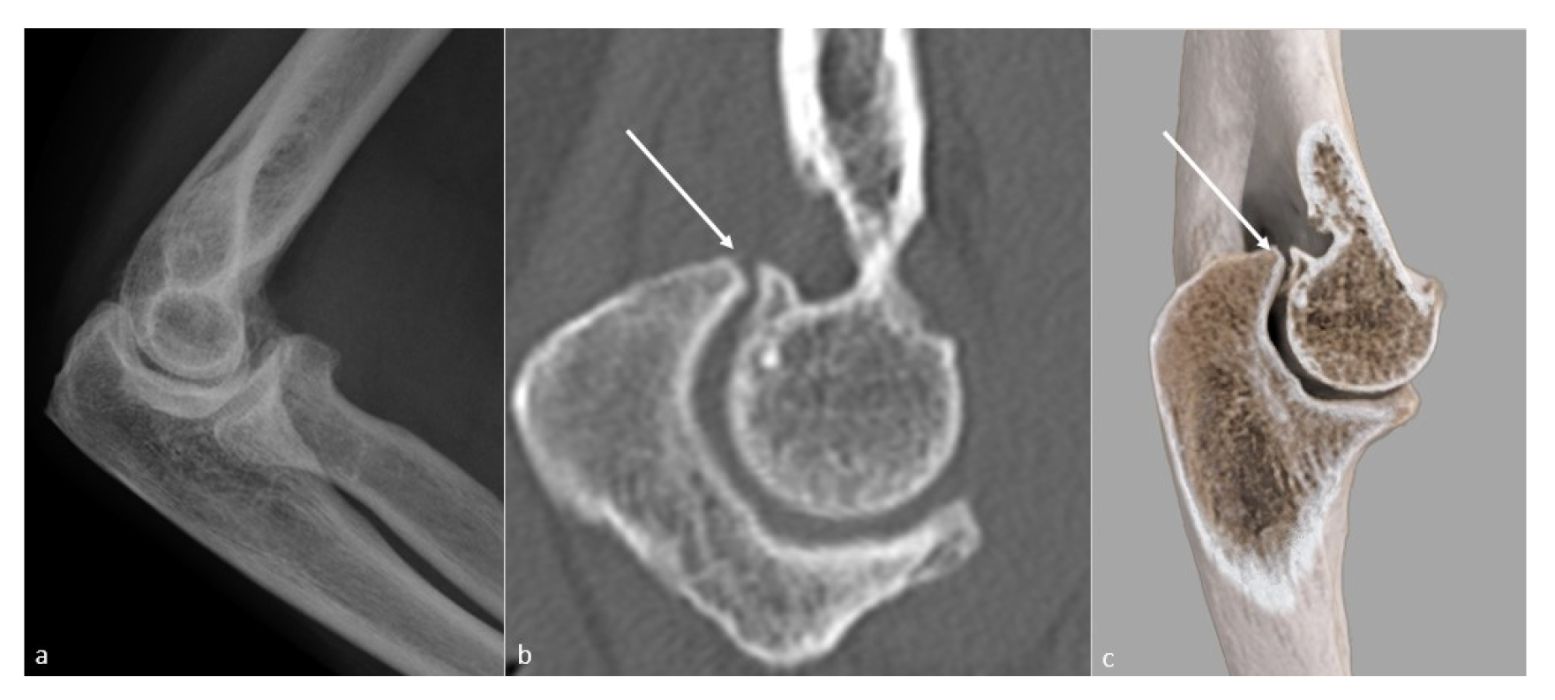
To find out more about each type of scan and what it involves, see our guide to imaging and scans for the upper limb.
Treatment without surgery
Many people manage elbow arthritis well without an operation, particularly in the early stages. Mr Jepson will usually suggest trying these measures first.
Activity changes
Resting from the tasks that aggravate the elbow and finding easier ways to do them.
Physiotherapy
Exercises to keep the elbow moving and strengthen the muscles that support it.
Medication
Anti-inflammatory painkillers, if they are suitable for you, can ease pain and swelling.
Steroid injections
An injection into the joint can settle inflammation and give a period of relief.
If your symptoms do not improve, or catching, locking and stiffness are limiting your life, surgery may be worth considering.
Elbow arthroscopy (keyhole surgery)
The word arthroscopy simply means looking inside a joint. Mr Jepson passes a slim camera into the elbow through a small cut, and the picture appears on a screen. Fine instruments are then introduced through other small cuts to treat the problem he can see.
Because the cuts are so small, keyhole surgery tends to cause less pain and stiffness than open surgery, and recovery is often quicker.
The elbow is one of the more demanding joints to operate on in this way, because important nerves lie very close to it. That is why careful planning, often with a CT scan, and experience matter.
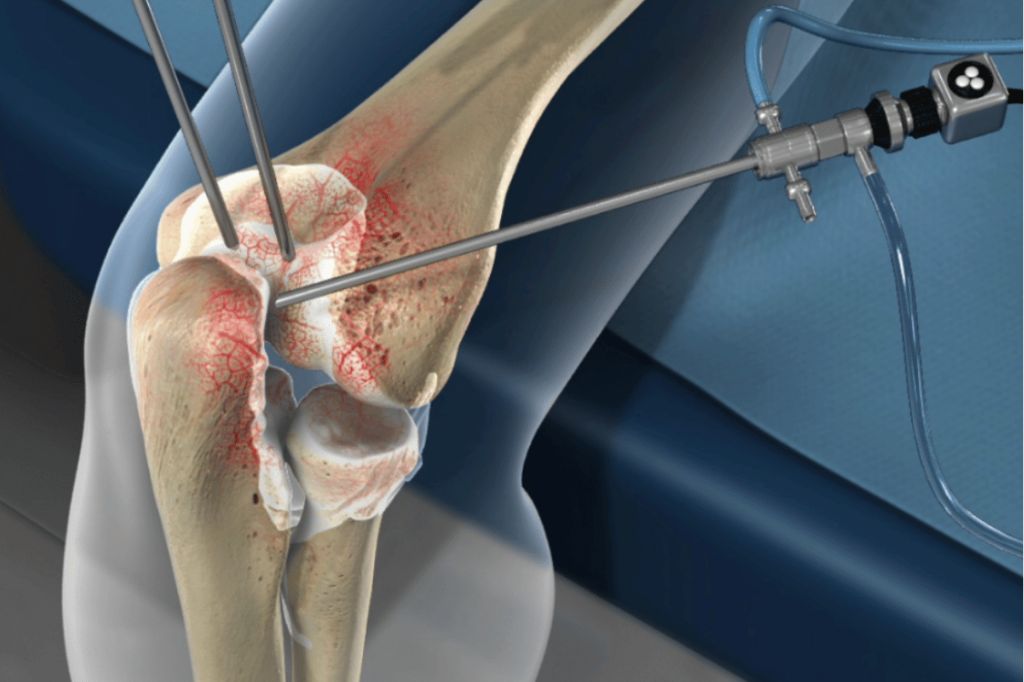
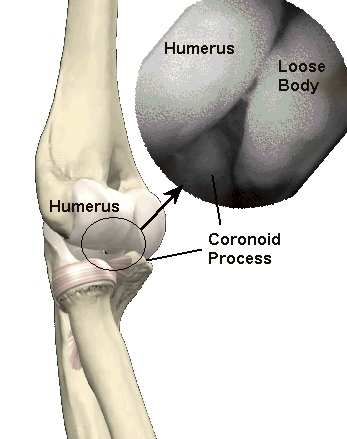
What keyhole surgery can treat
- Removing loose fragments that cause catching or locking.
- Removing bone spurs and releasing tight scar tissue to improve how far the elbow bends and straightens.
- Cleaning out a joint affected by osteoarthritis or rheumatoid arthritis.
- Treating osteochondritis dissecans.
- Treating some fractures around the elbow.
- Treating tennis elbow when other measures have not helped - see our tennis elbow guide.
When open surgery is better
Keyhole surgery is not the right choice for every elbow problem. Some operations are still best done through a conventional open incision, and Mr Jepson will explain which approach suits you.
Golfer's elbow
Surgery for tendon problems on the inner side of the elbow.
Ligament repair
Repairing or reconstructing the collateral ligaments that keep the elbow stable.
Some fractures
Breaks that need fixing with plates or screws.
Cubital tunnel release
Freeing the ulnar nerve when it is squeezed on the inner side of the elbow.
Open removal of loose bodies
An arthrotomy opens the joint directly to remove fragments when keyhole access is not suitable.
Elbow joint replacement
May be discussed for advanced arthritis when other treatments are no longer enough.
Combined approaches
Sometimes both techniques are used together. For example, a loose fragment may be removed with the camera, and the damaged area of bone then repaired with a bone graft through a small open incision.
Your operation day
Knowing what will happen can make the day feel much calmer. Here is what to expect.
Before surgery
You will have a pre-operative assessment to check you are well enough for surgery. This may include blood tests, an ECG (heart tracing) or a chest X-ray.
Please tell the team about every medicine and supplement you take, as some may need to be stopped beforehand. Most people go home the same day, though occasionally an overnight stay helps with pain control or early therapy.
Your anaesthetic
Elbow arthroscopy is done under a general anaesthetic, a regional nerve block that numbs the whole arm, or a combination of both. Your anaesthetist will talk through the options with you.
The nerve block is sometimes given after the operation, so that the nerves to your hand can be checked first.
The procedure, step by step
-
Antibiotics are given to reduce the risk of infection.
-
You are positioned on your side or front with your arm resting in a holder, and pressure points are carefully padded.
-
A tourniquet is placed on the upper arm and the skin is cleaned.
-
Important structures, such as the ulnar nerve, are marked on the skin.
-
The joint is filled with fluid, which creates working space and moves nerves and blood vessels further away.
-
Small incisions are made for the camera and instruments.
-
The problem is treated - smoothing damaged surfaces, removing spurs and loose bodies, or releasing a tight joint capsule.
-
The incisions are closed with stitches or skin tapes, and a soft dressing or splint is applied.
For the full step-by-step guide, from pre-assessment and fasting to nerve blocks and going home, read the day of surgery guide.
Recovery
Most people go home the same day, a few hours after their operation. Please arrange for someone to drive you home and stay with you for the first night.
Pain relief
Take your painkillers regularly for the first few days, rather than waiting for pain to build.
Ice and elevation
For the first 48 hours, ice the elbow and keep it raised - elbow above your heart and hand above your elbow.
Keep moving
Move your fingers and wrist often, and begin gentle elbow exercises when you are advised to.
Your dressing
Keep the dressing clean, dry and in place until the team tells you otherwise.
Physiotherapy
A physiotherapist will guide you through exercises to restore movement and then strength.
Work and driving
This depends on what was done. After a smaller procedure some people are back at work within days; more extensive surgery can take months to recover from fully.
Possible risks
Most people have elbow arthroscopy without any significant problems. As with any operation, though, there are some risks, and it is important you know about them before deciding.
Because the elbow's nerves lie so close to the joint, elbow arthroscopy carries a slightly higher risk of infection and nerve irritation than keyhole surgery on the shoulder or knee. Most nerve irritation settles with time.
Mr Jepson will talk through the risks and benefits of your specific operation, and answer any questions, before you agree to go ahead.
Risks to be aware of
- Infection
- Bleeding or a haematoma (a collection of blood under the skin)
- Blood clots
- Ongoing or returning stiffness
- Injury to nerves or blood vessels near the joint
Consent with Concentric
Before any operation, Mr Jepson talks you through the benefits, these risks and the alternatives. The practice uses Concentric, a secure digital consent system, so you can read about your operation at home, ask questions and record your decision. Your consent is confirmed again on the day.
More in our day of surgery guide.
Common questions
Will elbow arthroscopy cure my arthritis?
No operation can replace worn cartilage. Keyhole surgery can, however, ease pain, stop catching and locking, and improve how far your elbow moves. The arthritis itself may continue to progress slowly over time.
Is it a day case?
Usually, yes. Most people go home a few hours after surgery. Occasionally an overnight stay is recommended for pain control or to start therapy.
When can I drive?
You can drive once you are off strong painkillers and can control the car safely, including in an emergency. This depends on the procedure, and Mr Jepson will advise you. It is also sensible to check with your insurer.
Will I need physiotherapy?
Most people do. Physiotherapy helps you regain movement early and then rebuild strength, and it plays a big part in getting the best result from your operation.
Who will carry out my operation?
Mr Jepson sees you in clinic and performs your surgery himself. You can read more about Mr Alistair Jepson and his training.
Where can I be seen?
Mr Jepson sees patients at Circle Three Shires Hospital in Northampton and Woodland Hospital in Kettering. Visit our clinic locations page for addresses and directions.
Related conditions
Other elbow problems that can cause similar pain, stiffness or tingling.
- Tennis elbow and golfer's elbow Tendon pain on the outer or inner side of the elbow. Read the guide
- Cubital tunnel syndrome Ulnar nerve pressure causing tingling in the ring and little fingers. Read the guide
- Olecranon bursitis A swollen, fluid-filled sac at the point of the elbow. Read the guide
- Distal biceps tendon rupture A torn biceps tendon at the front of the elbow, often felt as a pop. Read the guide
Talk to the practice about your shoulder, elbow, hand or wrist
Call to arrange a consultation, book online for Circle Three Shires Hospital in Northampton, or send a short email and the practice team will come back to you.
Read independent patient reviews on Doctify (opens in a new tab), iWantGreatCare (opens in a new tab) or Google reviews (opens in a new tab)