Dislocation
The ball comes completely out of the socket, usually forwards. It is very painful and often needs to be put back in hospital.
Patient guide · Shoulder
A shoulder that has dislocated, slips partly out of joint or simply feels unreliable can make you wary of sport, work and even everyday reaching. This guide explains why it happens, how labral and SLAP tears fit in, and the treatments Mr Jepson offers, from physiotherapy to keyhole stabilisation and the Latarjet procedure.

Written by Mr Alistair Jepson
Consultant Orthopaedic Surgeon · GMC 4104128
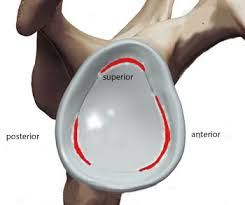
The shoulder is a ball and socket joint, but the socket (the glenoid) is shallow - more like a golf ball sitting on a tee than a ball in a cup. That shape gives the shoulder its remarkable range of movement, but it relies on soft tissues to keep the ball centred.
A ring of tough cartilage called the labrum deepens the socket, and the capsule and ligaments act like a sleeve around the joint. The rotator cuff and shoulder blade muscles then hold the ball steady as you move. When these structures are torn or stretched, the shoulder can slip out of position.
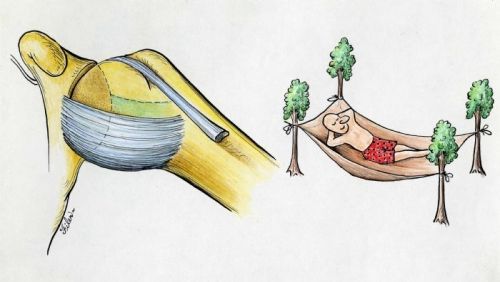
The ligaments at the front and bottom of the shoulder, known as the inferior glenohumeral ligament complex, work with the labrum around the rim of the socket to form a hammock-like sling that cradles the ball. When you lift your arm and turn it outwards, this hammock tightens to hold the ball in the socket.
A dislocation can stretch or tear the hammock and pull the labrum away from the bone. The shoulder is then looser, and more likely to slip out again.
The ball comes completely out of the socket, usually forwards. It is very painful and often needs to be put back in hospital.
The ball slips partly out and springs back on its own. People often describe a clunk, a sudden "dead arm" or a shoulder they no longer trust.
When the shoulder dislocates, the labrum is often torn away from the front of the socket. Without it, the joint loses part of its natural bumper and can slip again more easily.
Shoulder instability most often follows an injury, and it is particularly common in younger, active adults.
The first dislocation often happens in the late teens, twenties or thirties. Younger people are more likely to dislocate again after a first injury than older adults.
Rugby, football, martial arts and similar sports put the arm in exposed positions where a tackle or fall can force the ball out of the front of the socket.
Throwing, swimming, racket sports and climbing place repeated strain on the labrum and capsule, which can lead to looseness or a tear at the top of the socket.
Each time the shoulder comes out, it can tear the labrum further, stretch the capsule and chip or wear away bone from the socket and the ball. The more this happens, the easier the shoulder slips out again, and the more complex any repair becomes.
That is why it is worth seeing a shoulder specialist after a first dislocation, rather than waiting to see whether it happens again.
After the age of about 40, a dislocation is more likely to tear the rotator cuff than the labrum, so a scan is often advised - see the rotator cuff tears guide.
Some people have naturally loose joints and a shoulder that slips without a major injury. This usually responds best to a structured physiotherapy programme rather than surgery.
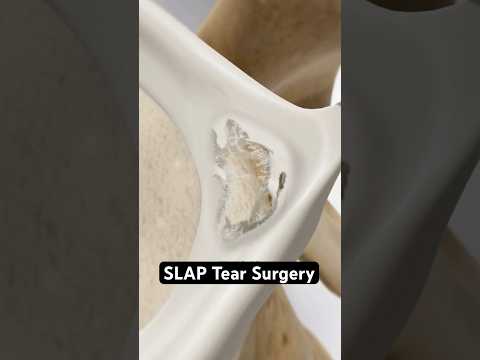
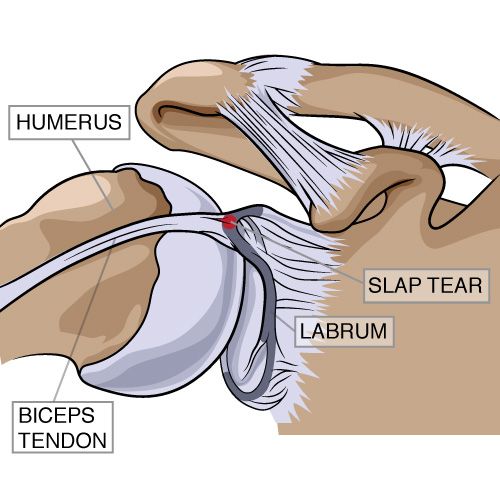
SLAP stands for Superior Labrum, Anterior to Posterior: a tear of the labrum across the top of the socket, from front to back.
This is where the long head of the biceps tendon anchors into the shoulder, so a SLAP tear often involves the biceps attachment too.
Keyhole SLAP repair, including a short video of the operation, is explained in arthroscopic stabilisation below.
A clear diagnosis tells Mr Jepson not only that the shoulder is unstable, but which structures are damaged and whether any bone has been lost - which shapes the right treatment.
How each episode happened, then gentle tests of movement, strength and the positions in which the shoulder feels at risk.
Confirm the joint is in place and show any obvious fracture or bony damage to the socket or ball.
Shows the labrum, capsule and rotator cuff. An MR arthrogram adds a small injection of dye into the joint to outline subtle labral and SLAP tears.
When bone loss is suspected, a CT scan with 3D images measures how much of the socket and ball has been worn away.
Not every unstable shoulder needs an operation. A focused physiotherapy programme strengthens and retrains the muscles that hold the ball centred in the socket.
Rehabilitation works on the rotator cuff and the muscles around the shoulder blade, and on the joint's sense of position, so the shoulder reacts quickly to protect itself. Physiotherapy is usually the first choice for shoulders that slip without a major injury, for some SLAP tears, and for people who are happy to adapt their activities.
Mr Jepson works closely with experienced therapists - you can read more about the team on the About page.
When the shoulder keeps slipping, or a tear is causing ongoing symptoms, keyhole surgery can repair the damaged structures through a few small incisions.
Using a camera inside the joint, Mr Jepson reattaches the torn labrum to the rim of the socket with small anchors and stitches, and tightens a stretched capsule. This restores the bumper at the front of the socket and the tension in the supporting tissues.
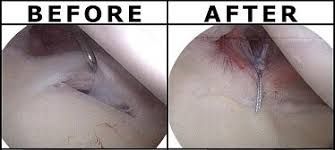
The torn labrum at the top of the socket is fixed back to the bone with anchors, restoring the biceps attachment. This suits younger patients with a well-defined tear.
This short clip shows a keyhole SLAP repair. The torn labrum at the top of the socket is fixed back to the bone with a small anchor and stitches, restoring the attachment of the biceps tendon.
This video shows a keyhole labral (Bankart) repair. The torn labrum at the front of the socket is reattached to the bone with small anchors, restoring the soft-tissue bumper that helps keep the ball in place.
For some SLAP tears, particularly in older patients or where the biceps tendon itself is damaged, the tendon is released from the labrum and fixed lower down the arm instead.
If an earlier repair has failed, Mr Jepson first finds out why. A further keyhole repair may be possible, or bone loss may mean a Latarjet procedure is the better option.
To see what happens on the day of your operation, from pre-assessment and fasting to the nerve block and going home, read the day of surgery guide.
Repeated dislocations can chip or wear away the front edge of the glenoid socket. A normally pear-shaped socket becomes narrower at the front, leaving less bone for the ball to sit against.
A dent can also form in the back of the ball where it strikes the socket edge. When enough bone has gone, reattaching the labrum alone is less reliable, because the socket itself is too small to hold the ball - however well the soft tissues are repaired. A CT scan helps Mr Jepson judge when this point has been reached.
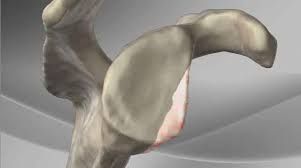
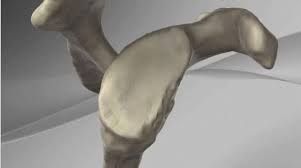
When the shoulder dislocates forwards, the back of the ball (the humeral head) can be dented against the rim of the socket. This leaves a groove called a Hill-Sachs lesion.
If the groove is large enough, it can catch, or "engage", on the edge of the socket as the arm is raised and turned outwards. That can let the shoulder slip out again, even after the labrum has been repaired.
Remplissage - French for "filling" - is a keyhole procedure done at the same time as the labral repair. The back of the capsule and the infraspinatus tendon are stitched into the groove with small anchors, so the defect sits outside the joint and can no longer catch.
Mr Jepson recommends it when scans show a Hill-Sachs lesion that is likely to engage. The main trade-off is that some patients notice a little loss of outward rotation, which he will discuss with you before deciding together.
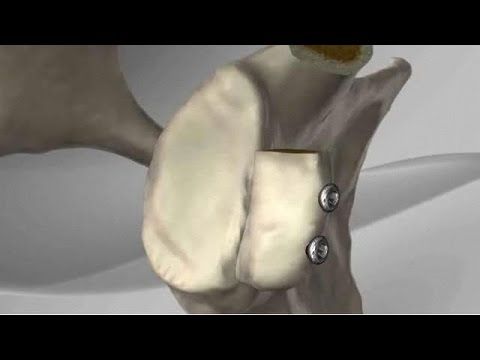
When significant bone has been lost from the socket, the Latarjet procedure rebuilds it.
A small piece of bone called the coracoid - a hook-shaped projection from the shoulder blade - is moved, with its attached tendon, to the front of the socket and fixed in place with screws. This widens the socket again and gives the ball a solid edge to sit against.
The transferred tendon also acts as a sling across the front of the joint when the arm is raised and turned outwards - the position in which most dislocations happen. The Latarjet is a larger operation than keyhole stabilisation, and Mr Jepson will talk through whether it is right for you, what it involves and what to expect afterwards.
Every recovery plan is tailored to the operation, your job and your sport, but most follow the same staged pattern.
A sling for the first few weeks lets the repair heal, with gentle exercises for the elbow, wrist and hand.
Guided physiotherapy gradually restores movement, within limits that keep the repair safe.
Strength and control are built up once movement returns, so the muscles can support the joint again.
Sport comes back step by step. Contact and overhead sports come last, once strength and confidence are fully restored.
Returning to driving, work and sport depends on the procedure and your progress. Mr Jepson and your physiotherapist will give you personal guidance at each stage.
If your question is not answered here, call the practice and the team will be glad to help.
Go to your nearest emergency department so the shoulder can be checked, X-rayed and put back safely. Afterwards, it is worth seeing a shoulder specialist so any labral, rotator cuff or bone damage is picked up early.
Not necessarily. It depends on your age, your sport and what the scans show. Some people do well with physiotherapy alone; for younger people in contact or overhead sports, an early repair may be worth discussing. Mr Jepson will go through the options with you.
Many people improve with physiotherapy and activity changes, and surgery is usually considered only when pain, clicking or weakness carry on despite good rehabilitation.
The two can feel similar and sometimes occur together, especially after a dislocation in later life. Examination and a scan will tell them apart. You can read more in the rotator cuff tears guide.
This mainly depends on how much bone has been lost from the socket, as well as your sport and whether you have had surgery before. A CT scan helps make that decision, and Mr Jepson will explain his reasoning clearly.
There is no fixed date. When you can drive again depends on the stabilisation or repair you have had, how long your arm needs to stay in a sling and how quickly active movement returns. To drive safely, you must be able to move your shoulder yourself, without help and without risking the repair, and react normally in an emergency.
UK rules expect drivers to steer with both hands unless the DVLA has given specific permission otherwise. You are responsible for being in control of the car at all times, and should be able to show this if you are stopped by the police.
Do not drive while taking strong painkillers that can make you drowsy, such as opioids, or for at least 24 hours after an anaesthetic. You only need to tell the DVLA if problems affecting safe driving are likely to last more than three months after your operation.
Before you start driving again, check with Mr Jepson, your physiotherapist and your motor insurer.
In short
Mr Jepson holds private clinics at Circle Three Shires Hospital in Northampton and Woodland Hospital in Kettering. Addresses and directions are on the clinic locations page.
Other shoulder problems that can cause similar pain, weakness or loss of confidence in the joint.
Call to arrange a consultation, book online for Circle Three Shires Hospital in Northampton, or send a short email and the practice team will come back to you.
Read independent patient reviews on Doctify (opens in a new tab), iWantGreatCare (opens in a new tab) or Google reviews (opens in a new tab)