
Elbow condition guide
Distal biceps tendon rupture
A sudden pop at the front of the elbow while lifting, followed by bruising and a change in the shape of your arm, is often the biceps tendon pulling away from the bone. This guide explains how the injury is diagnosed, when a repair makes sense, what the operation involves and what recovery looks like.
Timing matters with this injury. If you think you may have torn your biceps tendon, it is worth being seen promptly rather than waiting to see if it settles.

Written by Mr Alistair Jepson
Consultant Orthopaedic Surgeon · GMC 4104128
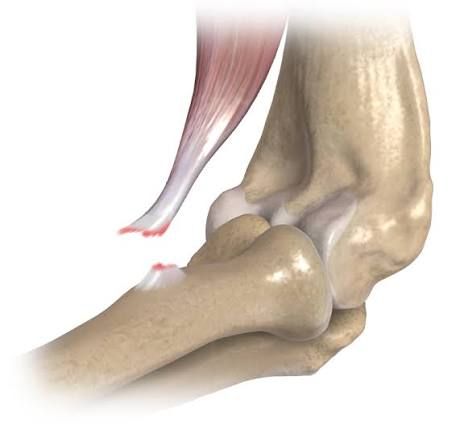
The distal biceps tendon and what it does
The biceps is the large muscle at the front of the upper arm. At its lower end it narrows into a strong tendon that crosses the front of the elbow and attaches to a small bump on the radius, one of the two bones of the forearm. This lower attachment is called the distal biceps tendon.
When the tendon tears away from the radius, the muscle is still healthy but it is no longer connected to the forearm, so it cannot do its work. This guide is about that lower attachment at the elbow, which is a different injury from a tear of the biceps tendon at the shoulder.
Bending the elbow
The biceps helps bend the elbow. Another muscle underneath it, the brachialis, does much of this work too, which is why many people can still bend their arm after the tendon has torn.
Turning the palm upwards
Its main job is supination: turning the forearm so the palm faces up, as when you turn a key, use a screwdriver or open a door handle. This is where weakness shows most clearly after a rupture.
How a rupture usually happens
Most ruptures happen in a single moment, when a heavy load suddenly forces a bent elbow straight while the biceps is working hard against it. Typical examples are catching a falling heavy object, lifting one end of a piece of furniture, pulling on a stuck item or the lowering phase of a heavy lift in the gym.
The tendon has often been weakened gradually beforehand, without any warning signs, so the injury can happen during an effort you have made many times before.
A similar kind of sudden overload can tear the large chest muscle where it attaches to the arm. If that sounds closer to your injury, see the guide to pectoralis major tendon tears.
Who it affects
- Most often men in middle age, usually in the dominant arm.
- Smokers are at higher risk, as smoking affects the blood supply and health of the tendon.
- People who do heavy manual work or weight training.
- Anabolic steroid use also weakens tendons and raises the risk.
- Women can be affected, but less often.
Symptoms
The signs are usually clear in the hours and days after the injury:
-
A sudden pop or tearing feeling
Felt at the front of the elbow at the moment of injury, often with sharp pain that eases over a few hours.
-
Pain and bruising
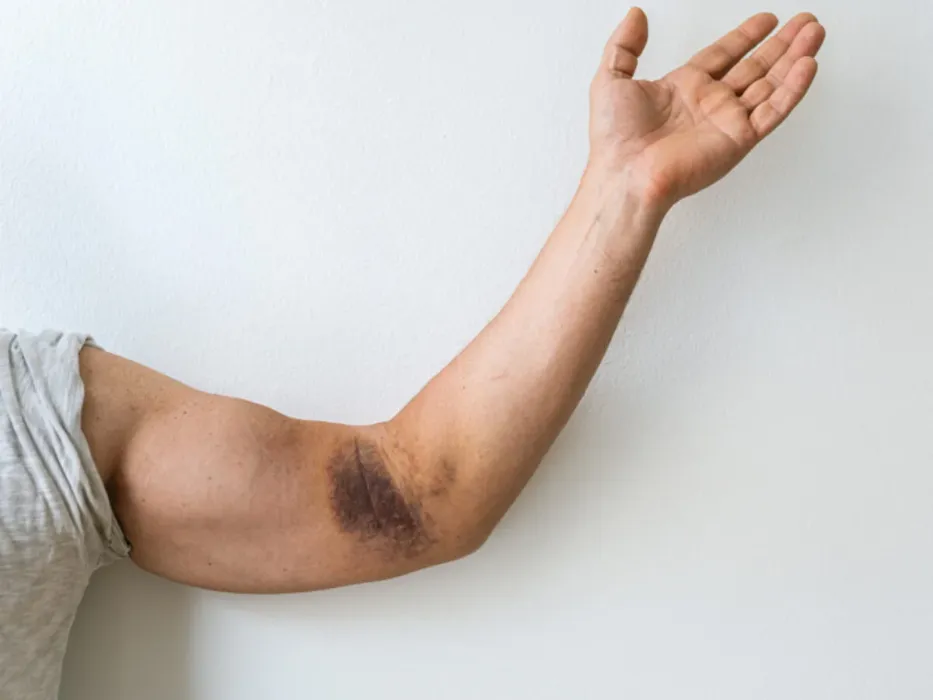
Aching at the front of the elbow, with bruising that appears over the next day or two and spreads down the forearm.
-
A change in the shape of the arm
The biceps muscle bunches higher up the arm because nothing holds it down. This is sometimes called a reverse Popeye sign.
-
Weakness turning the forearm
Turning a key, using a screwdriver or opening a door handle feels weak or tiring. Bending the elbow is often still possible.
Because you can usually still bend your elbow, it is easy to assume nothing serious has happened. That is a common reason people are seen later than is ideal.
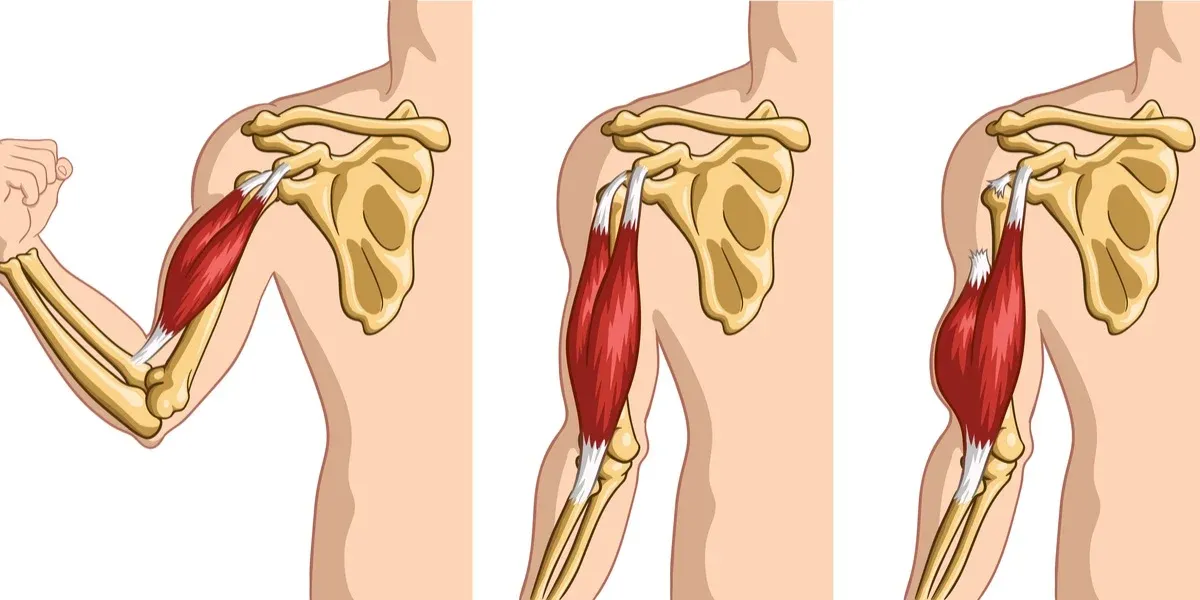
Distal or long head? The Popeye sign
A distal biceps rupture happens at the elbow, where the tendon pulls off the radius. It usually causes bruising at the front of the elbow and down the forearm, and the muscle belly moves up towards the shoulder, which is sometimes called a reverse Popeye sign. It weakens turning the palm up, such as using a screwdriver or turning a key, and bending the elbow. Because the tendon pulls back quickly, it is usually assessed and repaired early in active adults.
A long head of biceps rupture happens at the shoulder instead. The muscle drops towards the elbow and makes a rounded bulge in the upper arm, known as the Popeye sign. Strength is usually well kept, because the short head of the biceps is still attached. Most people manage well without surgery, although it can sometimes be a sign of rotator cuff wear that is worth checking.
Distal biceps rupture
- Where it happens
- At the elbow, where the tendon pulls off the radius.
- What you see
- Bruising at the front of the elbow and forearm, with the muscle bunched up towards the shoulder (reverse Popeye sign).
- Strength
- Weaker turning the palm up and bending the elbow.
- Usual treatment
- Early assessment, and usually an early repair in active adults.
Long head of biceps rupture
- Where it happens
- At the shoulder, at the top of the biceps.
- What you see
- The muscle drops towards the elbow, making a rounded bulge in the upper arm (Popeye sign).
- Strength
- Usually well kept, as the short head of the biceps is still attached.
- Usual treatment
- Most people manage well without surgery; the rotator cuff may be checked.
How it is diagnosed
A rupture can usually be recognised in clinic. A scan then confirms it and helps plan treatment.
-
History and examination
Mr Jepson will ask how the injury happened, then look at the shape of the arm, the bruising and the strength of bending the elbow and turning the palm upwards.
-
The hook test
With your elbow bent and palm turned up, he tries to hook a finger under the tendon at the front of the elbow. A healthy tendon feels like a firm cord. If it cannot be felt, the tendon has very likely come away from the bone.
-
Ultrasound or MRI
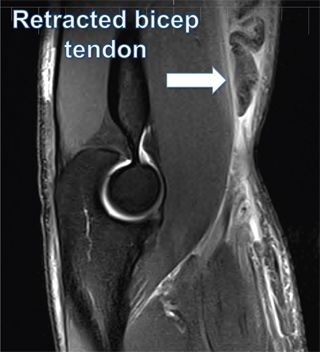
An ultrasound or MRI scan confirms the tear, shows whether it is complete or partial and how far the tendon has pulled back. This helps decide whether a direct repair is possible.
Read more about these scans and what to expect on the imaging and scans page.
Partial tears and similar elbow problems
Not every tear is complete. A partial tear leaves some of the tendon attached, so there may be no pop, little bruising and no change in the shape of the arm. Instead there is often a deep ache at the front of the elbow, especially when lifting or turning the forearm against resistance.
Many partial tears settle with a period of rest, changes to activity and guided hand therapy. If pain or weakness continues despite this, an operation to complete the release and reattach the tendon can be considered.
Conditions that can feel similar
- Tennis and golfer's elbow. Tendon pain on the outer or inner side of the elbow is sometimes mistaken for a partial biceps tear, and the other way round. See the guide to tennis elbow and golfer's elbow.
- Bicipital bursitis. Inflammation of the small fluid-filled sac that cushions the tendon near its attachment, which can cause swelling and pain in the same place.
- Elbow arthritis. Wear in the joint itself usually causes stiffness and aching rather than weakness turning the forearm. See the guide to elbow arthritis.
Treatment without surgery
Not everyone with a complete rupture needs an operation. Choosing not to repair the tendon can be a reasonable decision, particularly for people who are less physically active, do not rely on forearm strength for work or hobbies, or for whom surgery carries higher risk.
What it involves
Simple pain relief, ice and rest in the early days, then a gradual return to normal use with guidance from a hand therapist to keep the elbow moving and rebuild strength in the muscles that remain.
What usually improves
The pain and bruising usually settle over a few weeks. Most people can go back to everyday tasks, and bending the elbow often works well because other muscles take on that job.
What may remain
Some lasting weakness and fatigue when turning the forearm is common, for example with a screwdriver or repeated twisting. The bunched shape of the muscle stays, and some people notice cramping in the biceps.
Mr Jepson will talk through how much these changes are likely to matter to you, so that you can decide together whether a repair is worthwhile. Because repair is most straightforward early on, it helps to make this decision in the first few weeks.
Repairing the tendon
The aim of surgery is to reattach the tendon to the radius, where it belongs, so that the biceps can once again turn the forearm and help bend the elbow with normal strength.
How the repair is done
- A small incision is made at the front of the elbow, near the skin crease.
- The torn end of the tendon is found, cleaned up and secured with strong sutures.
- A small hole is drilled into the radius at the tendon's natural attachment point.
- A small cortical button, carrying the sutures, is passed through the bone and flipped so it sits flat against the far side.
- The sutures are then tensioned so the tendon slides down into the bone tunnel and is held firmly in place while it heals. This is known as a button and tension-slide technique.
The operation is usually done as a day case, under a general anaesthetic or a regional anaesthetic (a nerve block that numbs the whole arm), sometimes both. What happens on the day, from fasting to going home, is explained on the your day of surgery page.
Watch how a biceps repair is done
A short video showing how the torn tendon is reattached to the radius at the elbow.

The video shows the general steps of this type of repair. Mr Jepson will explain the details of your own operation at your consultation.
Why timing matters, and late tears
A direct repair is most straightforward within the first few weeks after the injury. Over time, the torn tendon pulls further up the arm, the muscle shortens and scar tissue forms around the end of the tendon. After this, it may no longer reach the bone without being stretched too tightly.
When the tendon cannot be brought back to the radius, it can be reconstructed with a tendon graft. The graft bridges the gap between the end of the biceps tendon and the bone and is fixed in a similar way to a standard repair. Recovery after a reconstruction is often slower, and the operation is more involved.
If you think you have torn the tendon
Ask to be seen promptly, even if the pain is settling and you can still bend your arm. An early assessment keeps every option open, including a straightforward repair.
Call 01604 633730Recovery after a repair
Every recovery is a little different, and Mr Jepson and your hand therapist will guide you through each stage. As a general outline:
-
Protection
A sling or splint for a short period after the operation, while the wound heals and the first swelling settles.
-
Early gentle movement
Gentle bending, straightening and turning of the forearm, guided by a hand therapist, to stop the elbow stiffening without straining the repair.
-
Light use
A gradual return to everyday tasks with light objects, as movement returns and your therapist judges the repair ready.
-
Building strength
Strengthening builds up over time. Heavy lifting and forceful pulling are avoided for several months while the tendon heals firmly into the bone.
Practical advice on wearing your sling, looking after the wound, managing pain and daily life at home is on the aftercare page.
Risks of surgery, explained plainly
Most people recover without problems, but every operation carries some risk. Mr Jepson will go through these with you before you decide.
-
Numbness on the outer forearm
A small skin nerve runs close to the incision. If it is irritated, a patch of numbness or tingling on the outer forearm can follow. This is usually temporary.
-
Infection
Uncommon. Signs include increasing redness, heat, discharge or fever, and need prompt attention.
-
Stiffness
Some loss of full straightening or turning of the forearm, which usually improves with therapy and time.
-
Extra bone formation
Occasionally bone forms in the soft tissues near the repair and can limit turning of the forearm. Rarely, further surgery is needed to remove it.
-
Injury to deeper nerves
Rare. Deeper nerves that control the wrist and fingers lie nearby and are carefully protected during the operation.
-
Re-rupture
The repair can fail, most often after a heavy load too early in recovery. Following the rehabilitation plan is the best protection.
Common questions
If your question is not answered here, the practice team is happy to help.
More guides for the shoulder, elbow, hand and wrist are on the conditions page.
Do I need surgery?
Not always. A repair is usually recommended for people who want to keep their full strength turning the forearm, for example for work, sport or hobbies. For some less active people, managing without surgery is a sensible choice. Mr Jepson will explain the options for your situation so you can decide together.
How soon should I be seen?
As soon as you reasonably can. A direct repair is most straightforward within the first few weeks after the injury, so an early assessment and scan keep all the options open.
Will I get my strength back?
After a successful repair, most people regain good strength for daily life, work and sport, though it builds gradually over several months. Without a repair, some weakness and fatigue when turning the forearm is common. Mr Jepson will talk you through what to expect in your case.
When can I drive, go back to work or return to the gym?
You can drive once you are out of the sling or splint and can control the car safely, including in an emergency; it is wise to check with your insurer. Desk-based work is often possible within a few weeks, while heavy manual work takes longer. Weight training and heavy lifting are built back up gradually over several months, guided by your therapist.
What kind of anaesthetic will I have?
Usually a general anaesthetic, a regional anaesthetic that numbs the whole arm, or a combination of the two. Your anaesthetist will discuss the choice with you on the day. More detail is on the your day of surgery page.
Where will I be seen and treated?
Mr Jepson consults at Circle Three Shires Hospital in Northampton and Woodland Hospital in Kettering. Addresses and directions are on the clinic locations page, and you can read about his training and experience on the about page.
Related conditions
Other elbow and upper arm problems that can cause similar pain, weakness or tendon injuries.
- Tennis elbow and golfer's elbow Tendon pain on the outer or inner side of the elbow. Read the guide
- Pectoralis major tendon tears A sudden tear of the chest muscle tendon while lifting. Read the guide
- Elbow arthritis and elbow arthroscopy Stiffness, aching and locking from wear in the elbow joint. Read the guide
- Rotator cuff tears Weakness and night pain from a torn shoulder tendon. Read the guide
Talk to the practice about your shoulder, elbow, hand or wrist
Call to arrange a consultation, book online for Circle Three Shires Hospital in Northampton, or send a short email and the practice team will come back to you.
Read independent patient reviews on Doctify (opens in a new tab), iWantGreatCare (opens in a new tab) or Google reviews (opens in a new tab)