
Shoulder guide
Shoulder arthritis and shoulder replacement
Arthritis of the shoulder wears away the smooth cartilage of the ball-and-socket joint, causing a deep ache, poor sleep and stiffness. This guide explains the two main types, osteoarthritis and rotator cuff tear arthropathy, how they are diagnosed, and how anatomical and reverse shoulder replacements work.

Written by Mr Alistair Jepson
Consultant Orthopaedic Surgeon · GMC 4104128
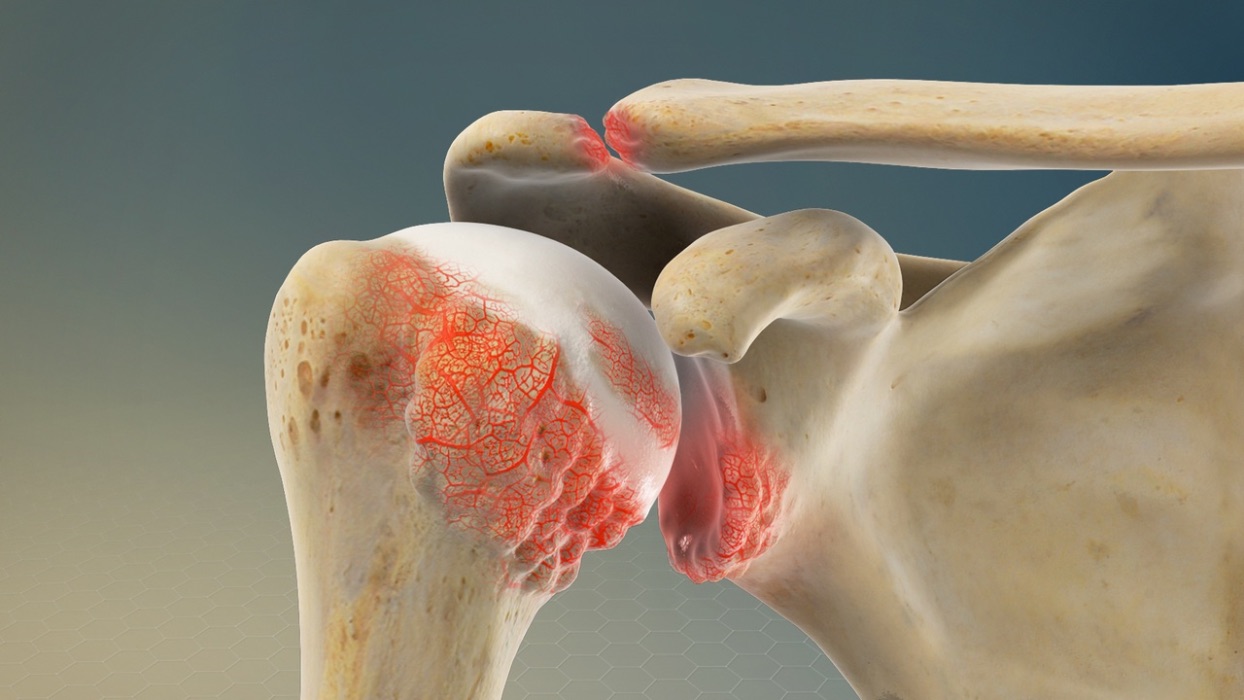
What is shoulder arthritis?
The main shoulder joint, the glenohumeral joint, is a ball-and-socket joint. The ball is the rounded head of the arm bone (humerus) and the socket is a shallow dish on the shoulder blade called the glenoid. Both surfaces are covered with smooth, slippery cartilage that lets the arm move freely in almost every direction.
In arthritis this cartilage gradually thins and roughens. As it wears, the bone underneath is exposed, the joint becomes inflamed, and small bony spurs (osteophytes) form around the edges. The result is pain, stiffness and a grinding feeling as the joint moves.
A shallow socket
The socket is small compared with the ball, which gives the shoulder its huge range of movement but relies on muscles to keep it centred.
The rotator cuff
Four tendons wrap around the ball and hold it in the socket. Whether they still work shapes which treatment suits you.
Cartilage wear
Cartilage has very little ability to heal, so once it has worn away, treatment aims to ease pain and keep you moving.
Two main patterns
Osteoarthritis with a working rotator cuff, and cuff tear arthropathy, where a long-standing cuff tear leads to joint wear.
Glenohumeral osteoarthritis
Osteoarthritis is the most common form of shoulder arthritis. The cartilage on the ball and socket wears away over time, while the rotator cuff tendons usually remain intact and working. The socket often wears unevenly, typically towards the back, and the ball can drift backwards with it.
It tends to affect people from middle age onwards, and may run in families or follow years of heavy use. Because the cuff still works, people with osteoarthritis often keep reasonable strength but find movement painful and increasingly stiff, particularly turning the arm outwards.
An intact cuff matters when it comes to surgery: it means an anatomical shoulder replacement is usually possible.
Other causes of shoulder arthritis
- Inflammatory arthritis - conditions such as rheumatoid arthritis inflame the joint lining and can damage the cartilage and, over time, the rotator cuff.
- Post-injury arthritis - a fracture into the joint or repeated dislocations can damage the joint surfaces and lead to arthritis years later.
AC joint arthritis is different
The acromio-clavicular (AC) joint, where the collarbone meets the top of the shoulder blade, is a separate, much smaller joint. Arthritis there causes pain at the top of the shoulder and is treated differently, often with an injection or keyhole removal of the worn end of the collarbone, rather than a replacement.
Rotator cuff tear arthropathy
Cuff tear arthropathy is arthritis that develops after a large, long-standing rotator cuff tear. Without the cuff tendons holding the ball down in the socket, the ball rides upwards each time the arm is lifted. Over months and years it rubs against the underside of the bony roof of the shoulder (the acromion) and against the top of the socket, wearing the joint.
People with cuff tear arthropathy have both arthritic pain and weakness. Lifting the arm forwards or out to the side can be difficult, and some people can no longer raise the arm above shoulder height at all.
If you want to know more about cuff tears themselves and when they can be repaired, see the rotator cuff tears guide.
How it develops
-
1
A large rotator cuff tear is left for a long time, and the torn tendons pull back and weaken.
-
2
With nothing holding it down, the ball of the arm bone rides high in the joint when you lift the arm.
-
3
The high-riding ball wears the cartilage and bone, leading to pain, weakness and loss of lifting.
Because the cuff cannot work, the usual surgical option is a reverse shoulder replacement.
Symptoms
Symptoms usually build up gradually over months or years. They can vary from day to day and are often worse after a busy day using the arm.
A deep ache
Pain felt deep in the shoulder, often spreading down the outside of the upper arm.
Night pain
Difficulty lying on the affected side and waking with pain, which can wear you down over time.
Stiffness
Gradual loss of movement, so reaching behind your back, doing up clothing or washing your hair becomes harder.
Grinding or clicking
A grating feeling or sound (crepitus) as the roughened joint surfaces move against each other.
Weakness
Especially in cuff tear arthropathy, where lifting the arm forwards or to the side may become difficult or impossible.
How shoulder arthritis is diagnosed
Diagnosis starts with a careful conversation and examination. Scans then confirm the arthritis, show the state of the rotator cuff and, if surgery is being considered, help plan it precisely.
-
1
Consultation and examination
Mr Jepson asks about your pain, sleep, work and the activities that matter to you, then checks the range of movement and strength of each part of the rotator cuff.
-
2
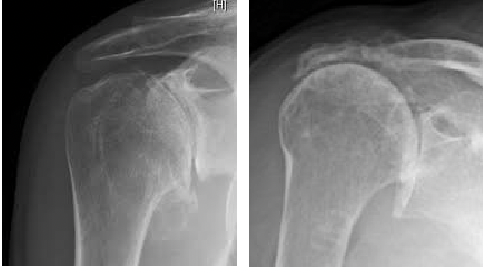
X-rays
X-rays show narrowing of the joint space, bony spurs and, in cuff tear arthropathy, the ball sitting high against the roof of the shoulder.
-
3
CT scan for planning
If a replacement is being considered, a CT scan shows the shape and depth of bone in the socket, so the size and position of the implant can be planned before the operation.
-
4
MRI or ultrasound for the cuff
An MRI or ultrasound scan checks the rotator cuff tendons and muscles, which helps decide between an anatomical and a reverse replacement.
To find out more about each type of scan and how they are chosen, see the imaging and scans guide.
Non-surgical treatment
Many people manage shoulder arthritis well without surgery, sometimes for years. Treatment is tailored to how much the shoulder is affecting your sleep, work and everyday life.
Activity changes
Pacing tasks, avoiding repeated heavy overhead work and adapting how you do things can reduce flare-ups.
Pain relief
Regular simple painkillers, and anti-inflammatory medicines where safe for you, can help, particularly at night.
Physiotherapy
Gentle exercises to keep movement and strengthen the muscles around the shoulder, including the deltoid in cuff arthropathy.
Image-guided injections
A steroid injection placed accurately into the joint under ultrasound guidance can settle pain for a period. They are usually avoided in the months just before a replacement.
When pain keeps you awake, stops you doing the things that matter to you, or no longer responds to these measures, a shoulder replacement is usually the most reliable way to relieve it.
Anatomical total shoulder replacement
An anatomical replacement recreates the shoulder's normal shape. The worn ball is replaced with a polished metal ball fixed to the top of the arm bone, and the worn socket is resurfaced with a smooth plastic (polyethylene) socket.
Because the new joint works in the same way as a natural shoulder, it depends on a healthy, working rotator cuff to keep the ball centred and to move the arm. It is therefore best suited to osteoarthritis where the cuff is intact.
The CT scan taken before surgery shows how much bone there is in the socket and whether it has worn unevenly, so the components can be sized and positioned to suit your shoulder.
Who it suits
People with painful osteoarthritis, a good rotator cuff and enough socket bone to support the plastic component.
Stemmed implants
The metal ball is attached to a stem that sits down inside the arm bone, giving secure fixation.
Stemless implants
The ball is fixed into the top of the arm bone only, preserving more bone where its quality allows.
Why the cuff matters
If the cuff is torn or not working, an anatomical replacement can become unbalanced and painful, which is why a reverse design is used instead.
Watch: an anatomical shoulder replacement
This short clip shows how an anatomical replacement recreates the natural shape of the joint, with a metal ball on the arm bone moving against a smooth plastic socket.
It can help to picture the new joint before your consultation, where Mr Jepson will explain how it would apply to your own shoulder.

Reverse shoulder replacement
A reverse replacement swaps the ball and socket around. A metal ball (the glenosphere) is fixed to the socket side on the shoulder blade, and a cup lined with smooth plastic is fixed to the top of the arm bone.
This changes the mechanics of the shoulder. The centre of rotation moves inwards and down, which tightens and lengthens the large deltoid muscle over the top of the shoulder. The deltoid can then lift the arm on its own, without needing a working rotator cuff.
That makes it the operation of choice when the cuff is badly torn or no longer working, relieving pain and helping many people lift the arm again.
When a reverse replacement is used
-
Cuff tear arthropathy - arthritis that has developed after a large, long-standing cuff tear.
-
Massive irreparable cuff tears - where the tendons cannot be repaired and the arm can no longer be lifted, even before arthritis has developed.
-
Some complex fractures - of the top of the arm bone, where the bone cannot be reliably fixed.
-
Revision surgery - replacing an earlier shoulder replacement that has failed or become unstable.
Watch: a reverse shoulder replacement
This short clip shows how a reverse replacement swaps the ball and socket around, so the deltoid muscle can take over the work of lifting the arm.
If a reverse design is being considered for you, Mr Jepson will talk through why it suits your shoulder and what to expect afterwards.

Choosing the right replacement
The choice depends mainly on whether your rotator cuff works, the bone in your socket, and what you want to get back to. Mr Jepson will talk you through which design suits your shoulder and why.
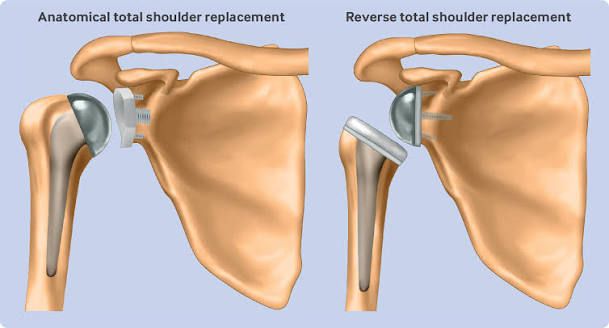
Anatomical replacement
- Metal ball on the arm bone
- Plastic socket
- Working rotator cuff
Reverse replacement
- Metal ball on the socket side
- Plastic-lined cup on the arm bone
- Deltoid muscle lifts the arm
| Feature | Anatomical | Reverse |
|---|---|---|
| Who it suits | Osteoarthritis with a healthy cuff and good socket bone | Cuff tear arthropathy, massive irreparable cuff tears, some fractures and revision surgery |
| Rotator cuff | Must be intact and working | Not needed - the deltoid lifts the arm |
| How it works | Recreates the natural ball and socket | Swaps the ball and socket to change the shoulder's mechanics |
| Movement to expect | Good pain relief, with movement that can come close to a natural shoulder once rehabilitation is complete | Good pain relief and better lifting; turning the arm and reaching behind the back may stay more limited |
Risks of shoulder replacement
Most people recover without problems, but every operation carries risks. Mr Jepson will discuss how they apply to you.
- Infection
- Dislocation of the new joint
- Nerve injury
- Fracture around the implant
- Stiffness
- Loosening or wear of the components over time
Consent with Concentric
Before a shoulder replacement, Mr Jepson talks you through the benefits, risks and alternatives. The practice uses Concentric, a secure digital consent system, so you can read about your operation at home, ask questions and record your decision. Your consent is confirmed again on the day.
Mr Jepson carries out shoulder replacement at the private hospitals where he operates. You can find addresses and details on the clinic locations page.
Recovery after shoulder replacement
To see what happens on the day of your operation, from pre-assessment and fasting to the nerve block and your stay in hospital, read the day of surgery guide.
Recovery is gradual and steady. The pain of arthritis often eases early on, while strength and movement continue to improve over the following months as you work through your exercises.
In hospital
Most people stay in hospital for a short time, usually a night or two. A nerve block helps keep you comfortable after the operation, and you go home with pain relief.
Your sling
You wear a sling for several weeks to protect the shoulder while it heals, taking it off for washing, dressing and your exercises.
Staged physiotherapy
Physiotherapy starts with gentle movement, then progresses to active exercises and later to strengthening, at a pace set for your type of replacement.
Sleeping
Sleeping propped up on pillows, or in a reclining chair, with a pillow supporting the elbow is usually most comfortable for the first few weeks.
Driving
You should not drive while wearing the sling. Once you are out of it and can control the car safely, including in an emergency, you can return to driving. Let your insurer know.
Everyday life and work
Light everyday tasks return first. Desk-based work usually resumes sooner than manual work, and heavier lifting builds up over the following months.
From a patient's perspective
One of Mr Jepson's patients who has had a shoulder replacement writes an independent blog about their experience, and has kindly allowed it to be shared here.
The blog is a personal account and is not medical advice. Advice about your own shoulder should come from Mr Jepson or your care team.
Common questions
If your question is not answered here, the practice team will be glad to help. You can send an enquiry or call the practice.
How long does a shoulder replacement last?
Modern shoulder replacements are designed to last many years, and for many people they last the rest of their lives. How long yours lasts depends on things such as your age, activity level, bone quality and the type of replacement. Over time the components can loosen or wear, and a small number of people need further surgery. Mr Jepson will talk this through honestly with you.
Will I be able to lift my arm above my head?
Many people regain the ability to reach overhead for everyday tasks such as reaching a shelf or brushing their hair. How far you can lift depends on the type of replacement, the state of your muscles before surgery and how well you keep up your exercises. With a reverse replacement, lifting usually improves, but turning the arm outwards and reaching behind your back may stay more limited. Heavy repetitive overhead lifting is generally best avoided with any shoulder replacement.
When can I drive after a shoulder replacement?
There is no fixed date. When you can drive again depends on the type of replacement you have, how long your arm needs to stay in a sling and how quickly active movement returns. To drive safely you must be able to move the shoulder yourself, without help and without putting the new joint at risk, and you must be able to react normally in an emergency.
UK rules expect drivers to steer with both hands, unless the DVLA has given you specific permission otherwise. You are responsible for being in control of the car at all times, and you should be able to show this if you are stopped by the police.
Do not drive while taking strong painkillers that can make you drowsy, such as opioids, or for at least 24 hours after an anaesthetic. You only need to tell the DVLA if problems that affect safe driving are likely to last more than three months after the operation.
Before you start driving again, check with Mr Jepson, your physiotherapist and your motor insurer.
In short
- You must not drive one-handed.
- The recommended time in your sling is the minimum before you consider driving, not the point at which you can start.
- Return to driving when you can move your shoulder without help and react safely in an emergency.
- Telling your insurer is not always essential, but it is sensible.
Do I need to see a physiotherapist first?
No, you can be seen without having had physiotherapy first. Many people have already tried exercises before their appointment, which is helpful to know about. If physiotherapy has not been tried and the arthritis is at an early stage, Mr Jepson may suggest it as part of your treatment plan.
Do I need a referral, and will my insurance cover it?
If you are using private medical insurance, check your policy and contact your insurer before your appointment to get an authorisation number. Some insurers ask for a referral letter from your GP or physiotherapist. If you are paying for yourself, the practice team can explain the costs. You can find fees and insurance information on the home page.
Can my other shoulder be done too?
Yes, if both shoulders are affected, each can be replaced. They are done as separate operations, usually once the first shoulder has recovered well enough for you to manage everyday life on that side. Mr Jepson will advise on which shoulder to treat first and the timing of the second.
Related conditions
Other shoulder problems that Mr Alistair Jepson assesses and treats, which can cause similar pain or stiffness.
- Rotator cuff tears Torn shoulder tendons causing pain and weakness, and when they can be repaired. Read the guide
- Frozen shoulder A painful, stiff shoulder from a tight joint capsule, often mistaken for arthritis. Read the guide
- Calcific tendonitis of the shoulder Calcium deposits in the cuff tendons that can cause sudden, severe shoulder pain. Read the guide
- Shoulder instability and SLAP tears A shoulder that slips or dislocates, and tears of the cartilage rim of the socket. Read the guide
Talk to the practice about your shoulder, elbow, hand or wrist
Call to arrange a consultation, book online for Circle Three Shires Hospital in Northampton, or send a short email and the practice team will come back to you.
Read independent patient reviews on Doctify (opens in a new tab), iWantGreatCare (opens in a new tab) or Google reviews (opens in a new tab)