Upper Limb Clinic logo

Hand and wrist guide

Ganglion cysts of the wrist and hand

Ganglion cysts are harmless and can often be left alone. This guide explains where they appear, how they are diagnosed, and the options if yours is causing trouble. Those options range from reassurance and waiting, to drawing off the fluid with a needle, to surgery.

Mr Alistair Jepson

Written by Mr Alistair Jepson
Consultant Orthopaedic Surgeon · GMC 4104128

How a ganglion forms from a joint or tendon sheath
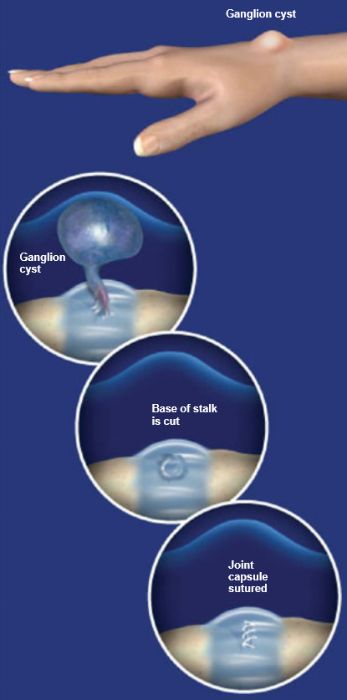
A ganglion arises from a joint or the lining of a tendon and fills with thick, clear, gel-like fluid.

What is a ganglion?

Ganglion cysts are the commonest type of swelling in the hand and wrist. They contain a thick, clear, gel-like fluid, and the lump resembles a water balloon on a stalk. They arise from a variety of structures, including joints and the lining of tendons.

They may fluctuate in size, and some may eventually disappear completely.

A ganglion cyst is not cancerous and will not spread to other areas.

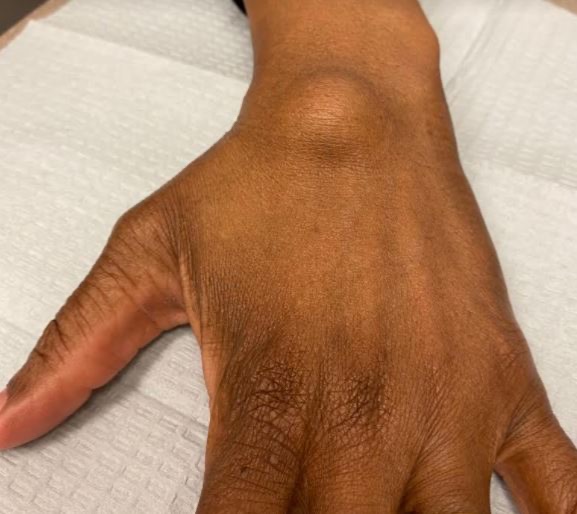
Dorsal wrist ganglion on the back of the wrist
A dorsal wrist ganglion: a smooth swelling in the middle of the back of the wrist, often more obvious when the wrist is bent forwards.

Where do ganglions occur in the hand and wrist?

There are four typical locations.

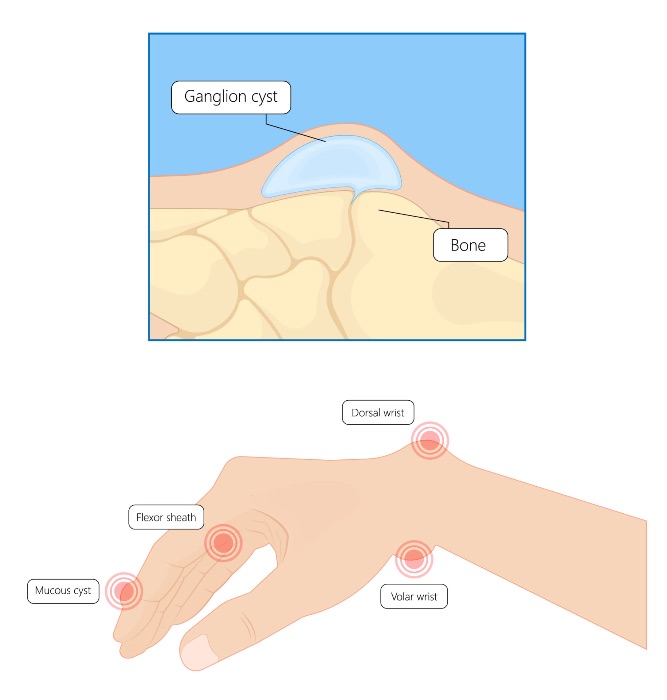
Common sites of ganglions around the hand and wrist
The four typical sites: the back of the wrist, the front of the wrist at the base of the thumb, the base of a finger on the palm side, and the end joint of a finger.
  1. The middle of the back of the wrist

    Dorsal wrist ganglion

    Arising from one of the extensor tendons, or from the wrist joint, coming through the scapholunate ligament.

  2. The front of the wrist at the base of the thumb

    Palmar wrist ganglion

    Next to where you can feel the pulse, arising from the wrist joint.

  3. The base of a finger on the palm side

    Flexor tendon sheath ganglion

    Arising from one of the tendon sheaths.

  4. The back of the end (tip) joint of a finger

    Dorsal digital ganglion

    Called a mucous cyst. See also the guide to finger arthritis of the DIP, PIP and MCP joints.

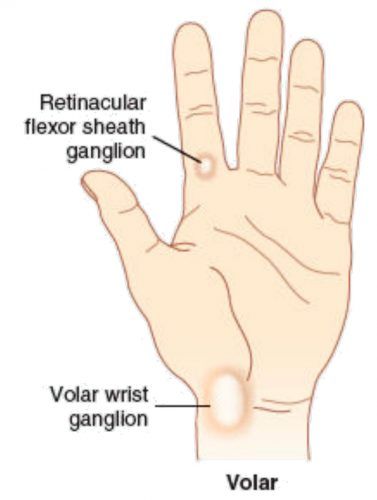
Ganglion on the palm side of the wrist
A palmar (volar) wrist ganglion on the front of the wrist, at the base of the thumb.

What problems do ganglions cause?

These swellings can be a nuisance.

Wrist pain with tingling can have other causes too, such as carpal tunnel syndrome or a TFCC tear.

  • Interference with movement

    If they become very large, they can interfere with wrist movement.

  • Aches and pains

    They can be associated with aches and pains in the wrist, but these often do not settle just by removing the swelling.

  • Pressure on a nerve

    Occasionally the swelling presses on a nearby nerve, causing pain or altered sensation.

What causes a ganglion?

No one really knows why these swellings appear in some people and not others.

Most arise spontaneously, but occasionally there is a history of injury to the wrist, or the nearby joint is starting to develop arthritis.

Some disappear completely on their own.

How is the diagnosis made?

The diagnosis is usually straightforward, as ganglion cysts tend to be smooth and round, fluctuate in size and occur at characteristic places in the hand and wrist. If the diagnosis is uncertain, scans and X-rays can help.

What investigations are useful?

  1. X-rays in an older person

    X-rays may be useful to look for arthritis in a joint near the ganglion, as the arthritis might also need treating to stop the ganglion returning.

  2. Checking the ligaments in a younger person

    In a younger person with symptoms in the wrist, not just around the swelling, investigations to exclude a ligament injury may be useful.

  3. Ultrasound or MRI if there is doubt

    If there is any doubt that the swelling is just a ganglion, an ultrasound or MRI scan may be arranged.

Read more about each scan in the imaging and scans guide.

What is the best treatment for my ganglion?

Ganglion cysts are harmless and can safely be left alone. Many disappear on their own (perhaps up to 50% if watched for several years), many others cause little trouble, and there are no long-term consequences from leaving a ganglion untreated.

The options

  1. Explanation, reassurance and waiting to see if the cyst disappears.
  2. Drawing off the fluid with a needle (aspiration) under local anaesthetic.
  3. Surgery to remove the cyst.

The recommendation for any cyst depends on where it is and the symptoms it causes. For example, a ganglion that grows very large may interfere with how the wrist works, and if this persists and is a real nuisance, surgical removal may be considered.

Treatment by type of ganglion

The figures below are general guides, not a prediction for any one person. Mr Jepson will talk through what applies to your ganglion.

Dorsal wrist ganglion

Who it affects
Typically young adults. These cysts often disappear on their own.
Aspiration
Possible, but up to 40% recur, because a root still connects the cyst to the joint.
Surgery
The risk of recurrence is lower, at around 10%, but problems can include persistent pain, loss of wrist movement and painful trapping of small nerve branches in the scar.

Palmar wrist ganglion

Who it affects
Young adults, or older patients with arthritis of the wrist.
Aspiration
May help, but needs care because the cyst often lies close to the artery at the wrist (where you feel the pulse), so it is usually done under ultrasound guidance.
Surgery
Recurrence after surgery is around 30%, and problems can include persistent pain, loss of wrist movement and small nerve branches trapped in the scar.

Flexor tendon sheath ganglion

Who it affects
Typically young adults. It is painful when gripping and feels like a dried pea in the palm.
Needle treatment
Puncturing it with a fine needle can disperse it, like popping a balloon, and fewer than 50% return.
Surgery
Persistent cysts can be removed surgically, with a small risk of recurrence.

Dorsal digital ganglion (mucous cyst)

Who it affects
Usually middle-aged or older people. It is associated with early osteoarthritis of the end joint of the finger.
Effects
Pressure from the cyst can cause a groove in the fingernail, and fluid occasionally leaks through the thin skin over it.
Surgery
Recurrence after surgery is around 10%, and problems can include infection, stiffness and pain from the arthritic joint. Read more in the guide to finger arthritis of the DIP, PIP and MCP joints.

A conservative approach

"Although my job title is surgeon, my preferred way of treating almost everything I see is without an operation, using injections and rehabilitation. The key thing is to give you, the patient, as clear an explanation of your options as I can, and some guidance on which is the most appropriate for you."

Mr Alistair Jepson, Consultant Orthopaedic Surgeon. Read more about Mr Jepson

Aspiration: often the first step

Why it is worth trying

Aspiration avoids an operation and lets you use your hand almost straight away, so if a ganglion needs treating it is often tried before surgery.

Aspiration means drawing off the gel-like fluid with a needle under local anaesthetic. It takes only a few minutes, and you can use your hand normally soon afterwards.

Because the root that connects the cyst to the joint stays in place, a ganglion can return after aspiration; the chance for each type is set out in treatment by type of ganglion. If it returns, it can be drained again, or surgery can be considered.

Ultrasound-guided drainage

For a palmar wrist ganglion, the needle is usually guided by ultrasound. The scan shows the cyst on screen while the needle goes in, so it can be placed precisely in the fluid and kept clear of nearby nerves and blood vessels.

It is a brief outpatient procedure under local anaesthetic, and you go home the same day.

Read more about ultrasound-guided procedures in the imaging and scans guide.

Watch: draining a ganglion under ultrasound guidance.

What does surgery involve?

The gel-filled sac, which comes from the tendon lining or a nearby joint, is removed.

The lump you see is often the tip of the iceberg. Much of the sac lies beneath the skin, between tendons, blood vessels and nerves, and down into the joint. Fully removing a ganglion is therefore a bigger task than it first seems, and it usually cannot be done under local anaesthetic alone. It is done as a day case, usually under a regional anaesthetic that numbs the whole arm, or a general anaesthetic.

Watch: ganglion surgery

A short clip showing how a ganglion is removed together with its root. It may help you picture the operation before you talk it through with Mr Jepson.

Two approaches

Open surgery

Through a cut, usually 2.5 to 5cm (1 to 2 inches) long, over the affected joint or tendon.

When a mucous cyst is removed, any bony spur on the end finger joint may be removed at the same time.

Arthroscopic (keyhole) surgery

Smaller cuts are made, and a tiny camera is used to guide the instruments inside the joint. This approach is suitable only for dorsal wrist ganglions.

Consent with Concentric

Deciding together, in your own time.

Agreeing to an operation is a conversation, not just a signature. Mr Jepson talks through what removing your ganglion involves, what it can and cannot achieve, the possible complications listed below, and the alternatives, including aspiration or leaving the lump alone.

The practice uses Concentric, a secure digital consent system. You are sent a link so you can read about your operation at home, share it with family, note down any questions and record your decision when you are ready. Your consent is checked again with you on the day, and you can change your mind at any point.

Read how consent fits into your journey, from pre-assessment to the anaesthetic and going home, in the day of surgery guide.

After surgery and possible complications

After surgery

Wound and pain relief

The wound is closed with stitches and covered with a bandage to keep it clean and protect it from knocks. It is not usually very painful, and you will have painkillers if you need them.

Splint and sling

After surgery on the wrist or hand you may have a splint or half plaster to limit movement while it heals, and a sling for the first few days to protect the arm and reduce swelling. Read the aftercare and sling guide.

Keep your fingers moving

Move your fingers regularly to keep the joints supple. If pain or stiffness lasts, hand therapy may be needed.

The scar

The scar can occasionally be thick and red, and for some people the skin around it stays numb.

Time off work

This depends on your job and where the ganglion was. Manual work may need longer off.

Driving

You can usually drive again once it feels safe to do so. Read the driving guidance.

Complications

Removing a ganglion is a minor procedure, so complications are rare and seldom serious.

  • Bleeding and bruising

    Short-term bruising is common and fades quickly.

  • Infection

    A minor infection can cause temporary stiffness, swelling or pain, and can be treated with antibiotics.

  • Nerve damage

    Short-term numbness around the scar is quite common, because the nerves in the hand and wrist are sensitive to stretching. Long-term nerve damage is infrequent.

  • Stiffness and pain

    Temporary stiffness, swelling or pain is possible. Permanent pain and stiffness, including complex regional pain syndrome (CRPS), is rare but can be disabling.

  • Recurrence

    Ganglions around the wrist are more likely to return than those in the finger. See treatment by type of ganglion.

  • General anaesthetic risks

    There is a very small risk to the heart and lungs. Pre-assessment tests before surgery help keep risks as low as possible.

Common questions

Can I burst or drain a ganglion myself?

Please do not. Hitting a ganglion with a heavy object to burst it is an old remedy that is best avoided: it can injure the hand and the surrounding tissues, and the cyst often returns. A mucous cyst connects to the finger joint underneath, so please do not pierce it yourself either.

When can I drive after ganglion surgery?

There is no fixed date. It depends on the operation you have had, whether you need a splint and for how long, and how quickly movement and grip come back. To drive safely you need to grip and steer without pain or weakness, and to react normally in an emergency so you do not cause injury to yourself or anyone else.

UK rules expect drivers to steer with both hands unless the DVLA has given specific permission otherwise, so your wrist and fingers need enough strength and movement to hold the wheel firmly. You are responsible for being in control of the car at all times, and should be able to show this if you are stopped by the police.

Do not drive while taking strong painkillers that can make you drowsy, such as opioids, or for at least 24 hours after an anaesthetic. You only need to tell the DVLA if problems affecting safe driving are likely to last more than three months after the date of your operation. Check with Mr Jepson, your hand therapist and your motor insurer before you start driving again.

In short

  • You must not drive one-handed.
  • There is no set time that suits everyone. If you are given a splint, the time you are advised to wear it is the minimum before you consider driving.
  • Return to driving when you can grip the wheel firmly and could react safely in an emergency, including an emergency stop.
  • Telling your insurer is not always essential, but it is sensible.

Do I need a referral, and will my insurance cover it?

Many insurers ask for a GP referral and an authorisation number before your first appointment, so check with them first. If you are paying for yourself, the practice team can advise on booking. Fees and the insurers Mr Jepson works with are on the home page.

Mr Jepson sees patients in Northampton and Kettering. See where Mr Jepson sees patients.

Talk to the practice about your shoulder, elbow, hand or wrist

Call to arrange a consultation, book online for Circle Three Shires Hospital in Northampton, or send a short email and the practice team will come back to you.

Read independent patient reviews on Doctify (opens in a new tab), iWantGreatCare (opens in a new tab) or Google reviews (opens in a new tab)

© 2026 Mr Alistair Jepson · Powered by Carebit