
Hand & wrist guide
Dupuytren's contracture
Dupuytren's contracture is a slow thickening of the tissue beneath the skin of the palm that can gradually draw one or more fingers down into the hand. This guide explains why it happens, who is likely to have a more active form, and the full range of options, from watching and waiting to radiotherapy, needle treatment and surgery, so you can decide calmly with Mr Jepson what is right for your hand.

Written by Mr Alistair Jepson
Consultant Orthopaedic Surgeon · GMC 4104128
Written for patients of Mr Alistair Jepson, Consultant Orthopaedic Surgeon specialising in the shoulder, elbow, hand and wrist.
Understanding the condition
What is Dupuytren's contracture?
Just beneath the skin of your palm lies a thin, tough layer of tissue called the palmar fascia. It anchors the skin so you can grip firmly without the skin sliding about.
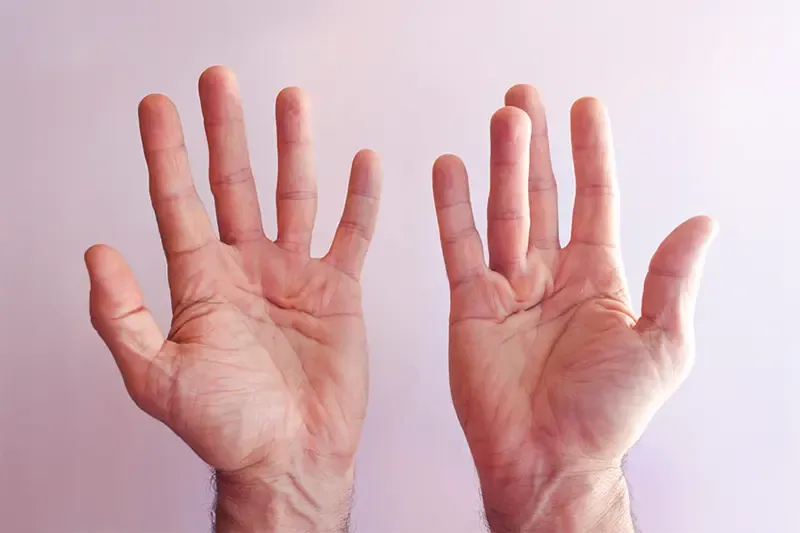
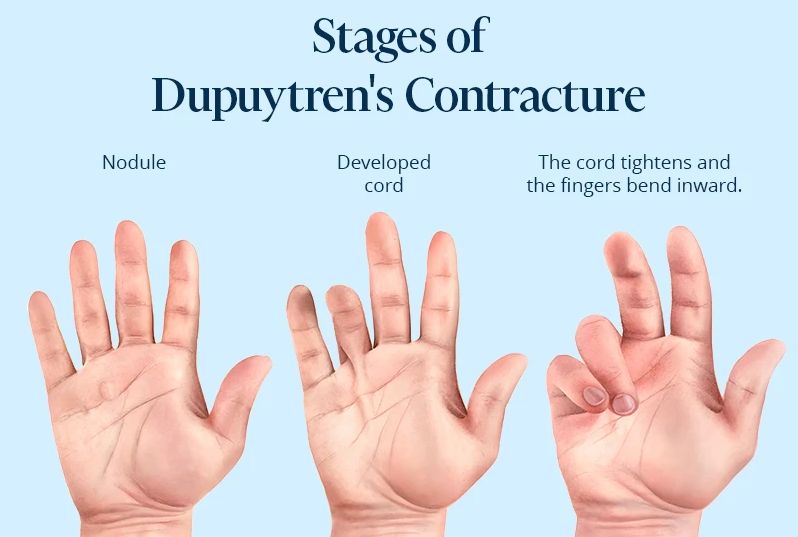
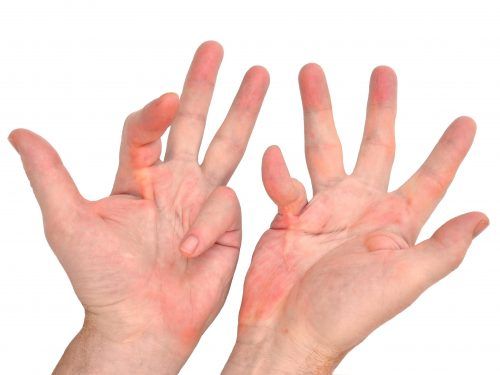
In Dupuytren's disease this fascia gradually thickens. It usually begins as a firm lump, or nodule, in the palm. Over months or years, some nodules extend into tight bands called cords, which run from the palm into the finger. As a cord shortens it pulls the finger down into the palm, most often the ring and little fingers.
The condition is usually painless. The tendons are not affected, so the finger can still bend normally; the problem is that it can no longer straighten fully.
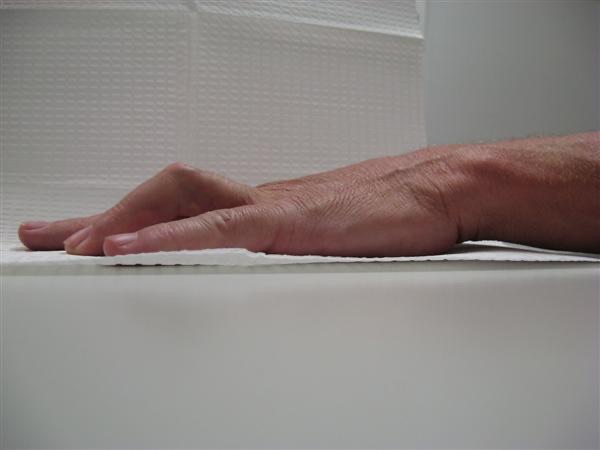
A simple check at home: the tabletop test
Place your hand palm down on a flat table. If your palm and fingers lie flat, the contracture is not yet affecting function. If a finger or the palm lifts off the table, it is worth having your hand assessed.
Watch: Dupuytren's contracture explained
This short clip shows how the nodules and cords of Dupuytren's form in the palm and why they gradually pull a finger down. It takes under a minute and is a helpful companion to the explanation above.

Why it happens
Causes and genetics
Dupuytren's is largely an inherited condition. The tendency is passed down in families, and a number of other factors make it more likely to appear or to progress.
- A strong family tendency
- It often runs in families. It is inherited in an autosomal dominant pattern with variable penetrance: a single copy of the tendency can be passed on, but not everyone who inherits it develops the disease, or develops it to the same degree.
- Ancestry
- It is most common in people of northern European ancestry, and much less common in other populations.
- Sex and age
- Men are affected more often than women and tend to develop it earlier. It becomes more common from middle age onwards.
- Associated factors
- Diabetes, smoking, higher alcohol intake and epilepsy (and some medicines used to treat it) are recognised associations.
It is not caused by your work
Dupuytren's is not caused by heavy manual work, using tools or how you use your hands. It is not something you have brought on yourself, and carrying on with normal activities will not make it develop.
A more active form
Dupuytren's diathesis
Some people have a more aggressive form of the condition, known as Dupuytren's diathesis. The word diathesis simply means a strong built-in tendency. Recognising it early matters, because it changes how quickly the disease is likely to progress and how well any treatment is likely to last.
No single feature makes the diagnosis. The more of the features below that apply to you, the more likely it is that your disease will behave actively.
Features of Dupuytren's diathesis
-
Young onset
The disease first appears at a younger age, generally under about 50.
-
Strong family history
A parent, brother or sister, or several relatives, have also had Dupuytren's.
-
Both hands
Disease in both hands rather than one.
-
Thumb and index side
Involvement of the thumb or index finger as well as the ring and little fingers.
-
Knuckle pads
Thickened pads over the back of the finger knuckles, known as Garrod's pads.
-
Ledderhose disease
Similar firm nodules in the sole of the foot.
-
Peyronie's disease
A related thickening of tissue in the penis that can cause it to curve.
-
Do mention them
Tell Mr Jepson about any of these, even if they seem unrelated to your hand.
Why diathesis shapes your treatment
People with diathesis tend to find their disease progresses faster, and it has a higher chance of coming back after treatment. That does not mean treatment is not worthwhile, but it does affect the choice and the timing.
For example, a needle procedure may give a shorter-lived result, an operation that also replaces the affected skin with a graft may be more durable, and radiotherapy may be worth discussing while the disease is still at an early stage.
At your consultation
How it is diagnosed
Dupuytren's contracture is diagnosed by talking with you and examining your hand. Scans are rarely needed.
-
Your history
When you first noticed a change, how quickly it has progressed, which everyday tasks it affects, whether relatives have had it, and any features of diathesis such as knuckle pads or nodules in the feet.
-
Examining the hand
Feeling for nodules and cords, checking the skin for pitting or tethering, and testing movement, sensation and circulation in each finger.
-
The tabletop test
Whether your palm and fingers can lie flat on a table, a simple sign of whether the contracture is starting to affect function.
-
Measuring each joint
The bend is measured separately at the knuckle (MCP joint) and at the middle joint of the finger (PIP joint) with a small hand-held protractor. These measurements guide treatment and let any change be tracked accurately over time.
The two joints that matter
- MCP joint
- The knuckle, where the finger meets the palm.
- PIP joint
- The middle joint of the finger.
Scans are rarely needed
An ultrasound or X-ray is only occasionally suggested, for example to rule out another cause of a lump or stiffness. Read more about imaging and scans.
Dupuytren's contracture or trigger finger?
The two are sometimes confused, because both can make a finger bend towards the palm and both can cause a lump in the palm. They are different conditions, though, and they are treated differently.
Dupuytren's contracture
- A gradual bend that develops over months or years, caused by thickened cords under the skin of the palm
- Usually painless
- The finger cannot be fully straightened, even when you help it with your other hand
- No clicking, catching or locking
Trigger finger
- The finger catches, clicks or locks, and may snap straight suddenly
- Often painful at the base of the finger
- The finger can usually be straightened with the other hand
A Dupuytren's nodule in the palm can be mistaken for the tender lump of trigger finger, which sits over the tendon at the base of the finger. The two conditions can also occur together in the same hand. An examination usually tells them apart, and Mr Jepson will explain which you have and what it means for treatment.
Read the trigger finger guide: symptoms, injection and release surgery
Watch: Dupuytren's or trigger finger?
This short clip covers both Dupuytren's contracture and trigger finger, and explains the differences between them, from how each one makes the finger bend to how they are treated.
If the catching or locking sounds more like your finger, read the full trigger finger guide.

Indications for surgery
When is treatment worth considering?
Many people with Dupuytren's never need treatment. No treatment removes the underlying tendency, so the aim is to restore useful hand function at the right moment, not to treat every nodule.
Usually best watched
- Nodules in the palm with no finger bend
- Mild disease that does not affect what you can do
- Changes that have stayed stable over time
A useful habit: photograph your hand flat on a table every few months, so you and Mr Jepson can see whether it is changing.
Treatment is considered when
- Your hand can no longer lie flat on a table
- There is a fixed bend at the knuckle (MCP joint) of roughly 30 degrees or more
- There is any fixed bend at the middle joint (PIP joint) that is causing you difficulty
- The bend gets in the way of work, hobbies or everyday tasks
Why the middle joint matters
Contractures at the PIP joint respond less well to treatment than those at the knuckle. The joint and its surrounding tissues stiffen the longer they are held bent, so a PIP contracture is less likely to straighten fully, even after a well-performed operation.
For that reason, once the middle joint of a finger starts to bend, it is sensible to be seen earlier rather than later. Knuckle contractures, by contrast, usually straighten well even when they are more marked.
Stretching, massage and splints on their own do not stop the condition progressing. The options below range from less invasive treatments to radiotherapy for early disease and open surgery. Mr Jepson will explain which suit your hand.
Less invasive options
Minimally invasive treatments
For some people a smaller procedure is a sensible first step. These options are compared side by side below.
-
Needle fasciotomy
Percutaneous needle aponeurotomy
- What it is
- Under local anaesthetic, a fine needle is passed through the skin to weaken and divide the cord at several points, and the finger is gently straightened. There is no open wound.
- Best suited to
- A well-defined cord in the palm causing a bend mainly at the knuckle (MCP joint).
- Recovery
- Quick. Most people use the hand for light tasks within a few days.
- Recurrence
- Higher, and sooner, than after open surgery. It can be repeated and does not rule out surgery later.
-
Collagenase injection
Previously known as Xiapex
- What it was
- An enzyme injected into the cord to soften it, followed by straightening the finger a day or so later.
- Availability
- No longer available in the UK since 2020, so it is not an option at present. You may still read about it online.
-
Steroid injection
Into a painful nodule
- What it is
- A small injection of steroid into a tender nodule to settle discomfort and soften it.
- Best suited to
- Nodules that are sore or irritable. It does not straighten a bent finger.
- Recovery
- Normal use straight away.
- Recurrence
- The effect can wear off and the injection may need repeating.
Needle fasciotomy is less suitable for cords inside the finger or bends at the middle joint, where the finger nerves run close to the cord. In these situations open surgery is usually safer and more effective.
Early disease
Radiotherapy for Dupuytren's
Low-dose radiotherapy is an option for early-stage disease, when there are nodules and cords but before a significant contracture has developed. Its aim is to slow the disease down.
It does not straighten a finger that is already bent, so timing matters. It is most worth discussing if your disease is active or you have features of diathesis.
NICE has published guidance on radiation therapy for early Dupuytren's disease, which can be talked through with you before you decide.
What it can do
Help slow or halt the progression of nodules and cords, and in some people soften them or ease discomfort.
What it cannot do
Correct a contracture that is already present. If a finger is bent, a procedure to release it is still needed.
Side effects
Short-term effects include redness and dryness of the treated skin. Longer term, the skin can stay drier than before, and there is a small long-term risk of cancer developing in the treated area. These will be explained fully before any treatment.
Working with Dr Richard Shaffer
Mr Jepson works with Dr Richard Shaffer, who provides radiotherapy for Dupuytren's disease. If your disease is at an early stage, Mr Jepson can discuss whether radiotherapy is suitable for you and arrange the referral.
Open surgery
Surgery for Dupuytren's contracture
An open operation removes the diseased tissue under direct vision, protecting the nerves and blood vessels as the finger is straightened. It is usually a day case, under a general anaesthetic or a regional block that numbs the whole arm, at the hospitals where Mr Jepson operates.
Limited (segmental) fasciectomy
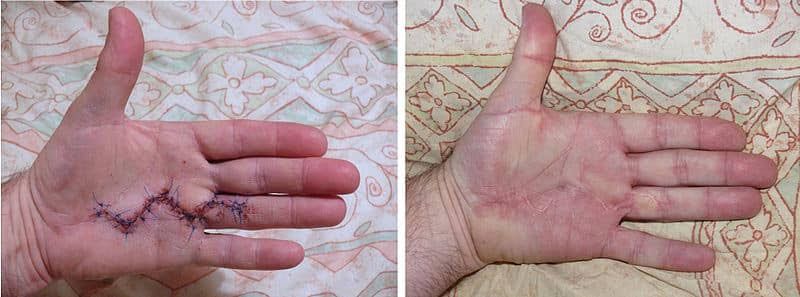
The standard operation. Through a zigzag incision in the palm and finger, the diseased cord is carefully separated from the finger nerves and arteries and removed, allowing the finger to straighten. It suits cords extending into the finger and bends at the middle joint.
Dermofasciectomy with skin graft
The diseased tissue is removed together with the overlying skin, which is replaced with a full-thickness skin graft. It is generally advised for disease that has come back after previous treatment, or for people with diathesis, because replacing the skin lowers the chance of recurrence beneath it.
Consent with Concentric
Before any procedure, Mr Jepson talks you through the benefits, risks and alternatives. The practice uses Concentric, a secure digital consent system, so you can read about your treatment at home, ask questions and record your decision. Your consent is confirmed again on the day.
To see what happens on the day of your operation, from pre-assessment to the anaesthetic and going home, read the day of surgery guide.
Making an informed choice
Risks of surgery
Most people do well after treatment, but it is important to understand what can go wrong. Mr Jepson will go through the risks that apply to your hand before you decide.
-
Nerve injury
The cord can wrap around a finger nerve. Injury to a digital nerve can leave numbness on one side of the finger.
-
Artery injury
A digital artery can be injured. Rarely this affects the circulation to the finger and the artery needs repair.
-
Recurrence
The disease can return. This is more likely with diathesis and after a needle fasciotomy.
-
Persisting contracture
The finger may not straighten completely, particularly when the PIP joint has been bent for some time.
-
Stiffness
Fingers can feel stiff while healing. Hand therapy helps, but some reduced bending can remain.
-
Wound problems
Delayed wound healing or loss of a small area of skin, which usually heals with dressings.
-
Infection
Uncommon, and usually treated with antibiotics.
-
Haematoma
A collection of blood under the skin, which occasionally needs draining.
-
Scar tenderness
The scar can be sensitive or firm for some months. Scar massage helps it settle.
-
Complex regional pain syndrome (CRPS)
Uncommonly, the hand becomes unusually painful, swollen and stiff after surgery. Early recognition and hand therapy help, so tell the team if your pain seems out of proportion to the operation.
Contact the practice if you notice
Increasing redness, swelling, pain or discharge from the wound, or a fever, after your procedure. If you cannot get through, seek urgent medical advice.
After treatment
Recovery
Recovery depends on the procedure and how advanced the contracture was. You will go home with clear written instructions, and the practice team is there if you have questions.
-
Dressings
Light dressings after a needle fasciotomy; a bulkier dressing for the first few days after surgery. Keep the hand raised to limit swelling. Stitches are usually removed at around two weeks.
-
Early hand therapy
A hand therapist starts gentle exercises early, helps with scar care and checks your progress. Doing the exercises regularly makes a real difference.
-
Night extension splint
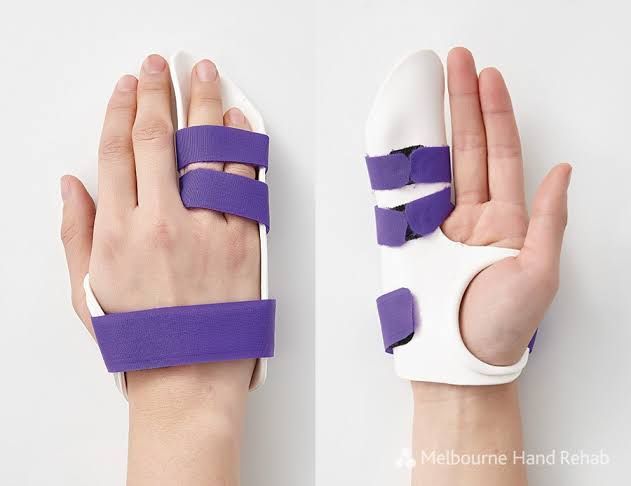
A custom splint worn at night for some months helps hold the finger straight while the tissues settle.
-
Driving and work
Drive only once you can grip the wheel firmly and control the car safely. Return to work depends on your job and the procedure, and will be discussed with you.
-
Mr Jepson works closely with experienced hand therapists. You can read more about the team on the About page.
Your questions
Common questions
If your question is not answered here, send an enquiry or call the practice and the team will come back to you.
Will it come back after treatment?
Can I wait and see?
Which treatment is best for me?
Is it caused by my job?
Will both hands need treatment?
Where is treatment carried out?
Related conditions
Dupuytren's can occur alongside, or be mistaken for, other hand problems. These guides may also help.
- Trigger finger and trigger thumb A finger or thumb that catches, clicks or locks as it bends. Read the guide
- Carpal tunnel syndrome Numbness and tingling in the thumb and fingers, often worse at night. Read the guide
- Finger arthritis: DIP, PIP and MCP joints Painful, swollen or stiff finger joints, and the options to ease them. Read the guide
- Ganglion cysts of the wrist and hand Smooth, fluid-filled lumps, including small cysts at the base of a finger. Read the guide
Talk to the practice about your shoulder, elbow, hand or wrist
Call to arrange a consultation, book online for Circle Three Shires Hospital in Northampton, or send a short email and the practice team will come back to you.
Read independent patient reviews on Doctify (opens in a new tab), iWantGreatCare (opens in a new tab) or Google reviews (opens in a new tab)