
Shoulder conditions
Calcific tendonitis of the shoulder
Calcific tendonitis happens when calcium builds up inside the rotator cuff tendons. It can cause sudden, severe shoulder pain, often at night, and it is one of the most painful shoulder conditions people experience. The good news is that it usually settles, and there are effective ways to speed that up.

Written by Mr Alistair Jepson
Consultant Orthopaedic Surgeon · GMC 4104128
Understanding the condition
What is calcific tendonitis?
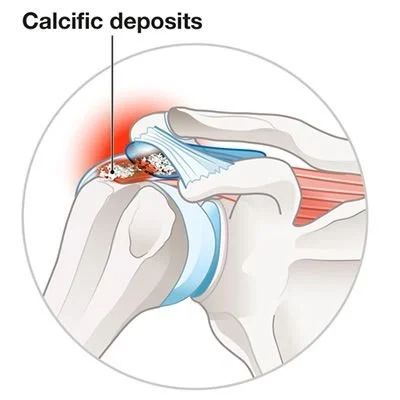
The rotator cuff is a group of four tendons that wrap around the ball of the shoulder joint, keeping it centred and helping you lift and rotate the arm. In calcific tendonitis, a deposit of calcium crystals forms within one of these tendons. It is most often found in the supraspinatus tendon, which runs across the top of the shoulder beneath the bony roof of the acromion.
The deposit is not caused by too much calcium in your diet, and it is not a sign of arthritis. The exact reason it forms is not fully understood, but it appears to be a change within the tendon itself rather than wear and tear.
Calcific tendonitis is a different problem from a torn tendon. If you would like to understand the rotator cuff in more detail, see the guide to rotator cuff tears.
Who tends to get it
It most often affects adults in middle age and is seen a little more often in women. It is less common in older people, when tendon wear and tears are more typical.
Associated conditions
Some people with diabetes or thyroid conditions seem more prone to it, although many patients have no other health problem at all.
One or both shoulders
It usually affects one shoulder at a time, but deposits can be found on both sides, sometimes without causing any pain.
Not always painful
Deposits are sometimes found by chance on an X-ray. A deposit that causes no symptoms does not usually need treatment.
Symptoms
Why it can hurt so much
A calcium deposit takes up space inside the tendon and can make it swell. When the body starts to break the deposit down, the surrounding tissue becomes inflamed and pressure builds within a tight space at the top of the shoulder. That is why the pain can arrive suddenly and feel out of proportion to anything you have done.
-
Sudden, severe pain
Often starting with no injury, and sometimes bad enough to need urgent pain relief.
-
Night pain
Difficulty sleeping, especially lying on the affected side.
-
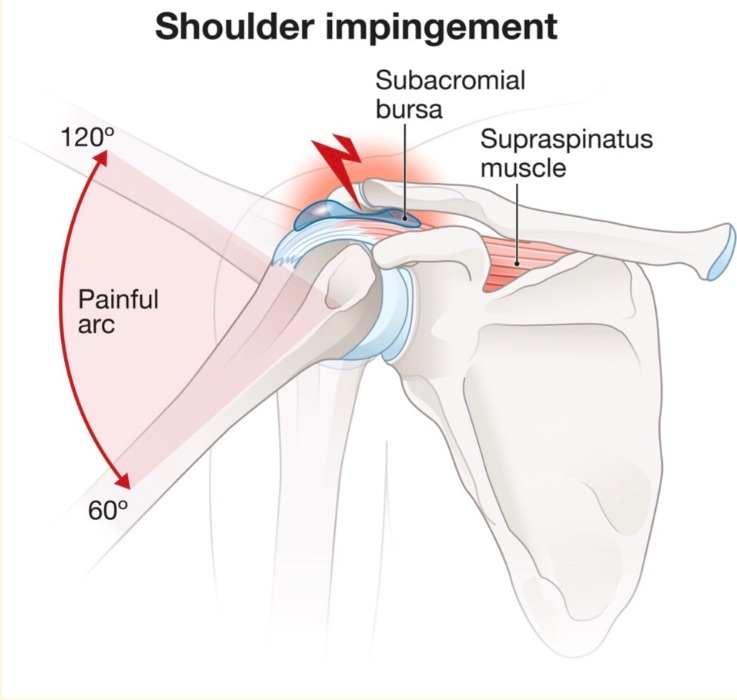
A painful arc
Pain through the middle part of lifting the arm out to the side, easing once the arm is higher or lower.
-
Catching and stiffness
A catching sensation with movement, and reluctance to use the arm because of pain.
How it develops
The formative and resorptive phases
Calcific tendonitis tends to follow a natural cycle. Knowing which phase you are in helps explain your symptoms and guides the choice of treatment.
Formative phase
Calcium is laid down within the tendon and the deposit is usually firm and chalky. Many people have only a dull ache, or catching when lifting the arm, and some have no symptoms at all. This phase can last for months or longer.
Resorptive phase
The body begins to break the deposit down. It softens to a toothpaste-like consistency and the tissues around it become inflamed. Calcium can leak into the bursa above the tendon. This is often the most painful phase, with sudden severe pain and night pain.
The resorptive phase is painful, but it is often a sign that the deposit is on its way out. For many people it comes before the calcium clears and the shoulder settles naturally. Treatment at this stage aims to control pain and, where helpful, speed the process up.
Diagnosis
Confirming the diagnosis
Several shoulder conditions can cause similar pain, so an accurate diagnosis matters before deciding on treatment. Mr Jepson will usually confirm calcific tendonitis at your first consultation.
Conditions that can feel similar
Shoulder pain and stiffness can also come from a frozen shoulder, a rotator cuff tear or pain referred from the neck. Examination and imaging help tell these apart.
-
Consultation and examination
A careful history of how the pain started and what makes it worse, followed by an examination of movement, strength and the painful arc. This also checks for stiffness that might point to another cause.
-
X-ray
Calcium shows up clearly on an X-ray. The size, shape and density of the deposit can give clues about which phase it is in.
-
Ultrasound scan
Ultrasound shows exactly where the deposit sits within the tendon, whether the bursa is inflamed and whether the tendon itself is healthy. It is also used to guide injections and barbotage. An MRI scan is occasionally added if a tear needs to be ruled out.
Treatment without surgery
Non-surgical treatment
Most people with calcific tendonitis improve without an operation. The first aim is to get the pain under control so that you can sleep and keep the shoulder moving.
Pain relief
Regular simple painkillers and, where suitable for you, anti-inflammatory medicines. Ice packs or a warm compress can also help during a flare. Your GP or pharmacist can advise on what is safe alongside any other medicines.
Physiotherapy
Gentle exercises keep the shoulder from stiffening and, as the pain eases, strengthen the rotator cuff and the muscles around the shoulder blade so the tendon is less likely to be pinched.
Ultrasound-guided steroid injection
A steroid and local anaesthetic injection into the inflamed bursa above the tendon, placed precisely under ultrasound. It can calm severe pain and make physiotherapy easier, particularly during the resorptive phase.
Ultrasound-guided needling
Barbotage
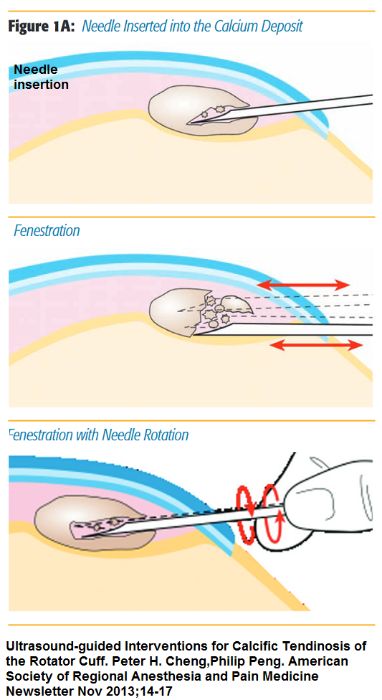
If pain continues despite simple measures, the deposit can be broken up and washed out with a needle. This is called barbotage (also known as lavage or needling). It is carried out under ultrasound guidance so the needle can be placed accurately into the calcium.
What happens
The skin and tissues are numbed with local anaesthetic. A fine needle is guided into the deposit, which is repeatedly flushed with sterile saline to break it up and draw calcium out.
Steroid to finish
A steroid injection into the bursa is often given at the end to reduce the inflammation the procedure can stir up.
An outpatient procedure
You are awake throughout and go home the same day. Someone else should ideally drive you home.
Who it suits
It works best for a well-defined deposit that can be clearly seen on ultrasound. Mr Jepson will advise whether it is right for you.
Keyhole surgery
Arthroscopic excision of calcific deposits
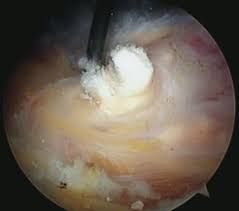
Surgery is considered when pain persists despite injections, physiotherapy and barbotage, or when the deposit is unsuitable for needling. Mr Jepson performs arthroscopic (keyhole) excision of calcific deposits, removing the calcium through small incisions using a camera.
The operation is usually done under general anaesthetic, often combined with a nerve block to keep the shoulder comfortable afterwards. The deposit is located within the tendon and carefully removed. If this leaves a weak area in the tendon, it can be repaired at the same time.
Subacromial decompression where needed
If the space beneath the acromion is narrowed, or the bursa is thickened and inflamed, Mr Jepson may also perform a subacromial decompression. This removes the inflamed bursa and, where necessary, smooths the underside of the bone to give the tendon more room to move without being pinched.
Consent with Concentric
Before any operation, Mr Jepson talks through the benefits, risks and alternatives with you. The practice uses Concentric, a secure digital consent system, so you can read about your operation at home, ask questions and record your decision. Your consent is confirmed again on the day. Read more about consent and your day of surgery.
To see what happens on the day of your operation, from pre-assessment and fasting to the nerve block and going home, read the day of surgery guide.
- Usually a day-case procedure
- Small keyhole incisions
- Tendon repaired at the same time if needed
Recovery
What to expect afterwards
Everyone recovers at their own pace, and Mr Jepson will give you a personal plan. The guidance below is general and is not a substitute for advice about your own shoulder.
After barbotage
- The shoulder is often sore for a few days as the anaesthetic wears off and the area settles. Regular painkillers and ice help.
- Use the arm gently for light everyday tasks, avoiding heavy lifting and overhead work for the first few days.
- Physiotherapy usually follows to restore movement and strength.
- Improvement tends to be gradual over the following weeks as the remaining calcium is cleared.
After keyhole surgery
- Most people go home the same day with the arm in a sling for comfort, which is used for a short time unless a tendon repair was needed.
- Physiotherapy starts early with gentle movement, building up to strengthening as healing allows.
- Return to desk work, driving and sport is gradual. You should only drive when you can control the car safely, and check with your insurer.
- If the tendon was repaired, recovery is slower and Mr Jepson will explain the timescales.
Contact the practice promptly if you develop increasing redness, swelling, a fever or pain that is getting worse rather than better after any procedure.
Questions
Frequently asked questions
If your question is not answered here, call the practice or send an enquiry and the team will help. You can also read more about Mr Jepson.
Will calcific tendonitis go away on its own?
Often, yes. Many deposits are eventually reabsorbed by the body, frequently after a painful resorptive phase. This can take time, so treatment aims to control pain and, where appropriate, speed things up.
Is it the same as a rotator cuff tear?
No. Both affect the rotator cuff, but calcific tendonitis is a calcium deposit within the tendon rather than a tear. An ultrasound scan tells them apart. Read more in the rotator cuff tears guide.
Could my pain be frozen shoulder instead?
The two can feel similar at first, with severe pain and night pain. Frozen shoulder causes marked stiffness in all directions, which examination will pick up, while an X-ray shows the calcium in calcific tendonitis. See the frozen shoulder guide.
Can the calcium come back?
It can occasionally recur, in the same shoulder or the other one, but once a deposit has cleared most people do not have further trouble. Keeping up your shoulder exercises helps the tendon stay healthy.
Will I need surgery?
Most people do not. Surgery is kept for pain that continues despite pain relief, physiotherapy, injection and barbotage. Mr Jepson will talk through every option with you before any decision is made.
When can I drive after treatment for calcific tendonitis?
There is no fixed date. It depends on whether you had barbotage or arthroscopic excision, whether you need a sling afterwards, and how quickly active movement returns. To drive safely you must be able to move your shoulder yourself, without help, and react normally in an emergency.
UK rules expect drivers to steer with both hands unless the DVLA has given specific permission otherwise. You are responsible for being in control of the car at all times, and you should be able to show this if you are stopped by the police.
Do not drive while taking strong painkillers that can make you drowsy, such as opioids, or for at least 24 hours after an anaesthetic. You only need to tell the DVLA if problems affecting safe driving are likely to last more than three months after your procedure.
Before you start driving again, check with Mr Jepson, your physiotherapist and your motor insurer.
In short
- You must not drive one-handed.
- Any recommended time in a sling is the minimum before you consider driving.
- Return to driving when you can move your shoulder without help and react safely in an emergency.
- Telling your insurer is not always essential, but it is sensible.
Where does Mr Jepson see patients?
Mr Jepson sees private patients in Northampton and Kettering. Addresses and directions for each hospital are on the clinic locations page.
Do I need a referral?
If you are using private medical insurance, check with your insurer whether they need a GP referral and an authorisation code before your appointment. The practice team can answer any other questions when you call.
Related conditions
Other shoulder problems that can cause similar pain, stiffness or weakness.
- Rotator cuff tears Torn shoulder tendons causing weakness and night pain, and how they are repaired. Read the guide
- Frozen shoulder Painful stiffness in every direction, with hydrodistension and capsular release. Read the guide
- Shoulder arthritis and shoulder replacement A worn shoulder joint, from injections to anatomical and reverse replacement. Read the guide
- Shoulder instability and SLAP tears Shoulders that dislocate or feel loose, including SLAP tears and stabilisation. Read the guide
Talk to the practice about your shoulder, elbow, hand or wrist
Call to arrange a consultation, book online for Circle Three Shires Hospital in Northampton, or send a short email and the practice team will come back to you.
Read independent patient reviews on Doctify (opens in a new tab), iWantGreatCare (opens in a new tab) or Google reviews (opens in a new tab)