
Elbow guide
Cubital tunnel syndrome
Tingling or numbness in your ring and little fingers, often worse when your elbow is bent, can come from pressure on the ulnar nerve as it passes behind the elbow. This guide explains why it happens, how it is diagnosed, and the options from simple changes at home to cubital tunnel release surgery.

Written by Mr Alistair Jepson
Consultant Orthopaedic Surgeon · GMC 4104128
The basics
What is cubital tunnel syndrome?
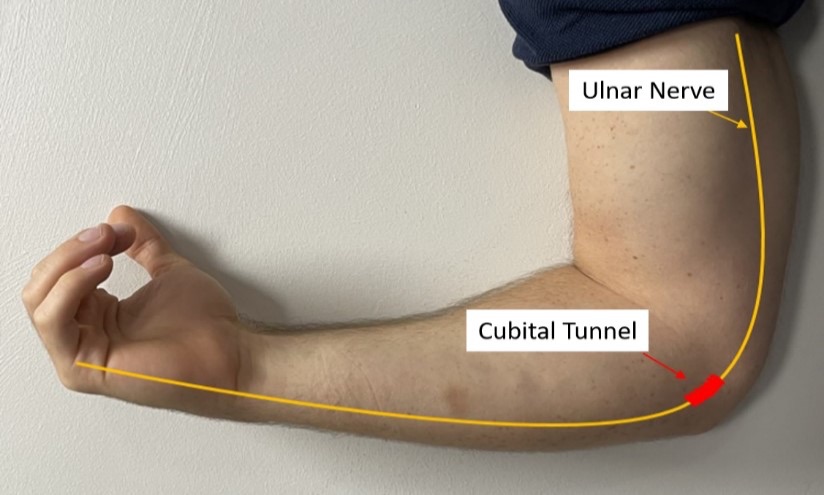
The ulnar nerve carries feeling to your ring and little fingers and controls many of the small muscles in your hand that give you fine movement, grip and pinch. On its way from the neck to the hand it passes behind the bony bump on the inner side of your elbow.
That bump is what most people call the "funny bone". If you have ever knocked it and felt a jolt shoot down to your little finger, you have felt the ulnar nerve, which sits just under the skin at this point with very little padding.
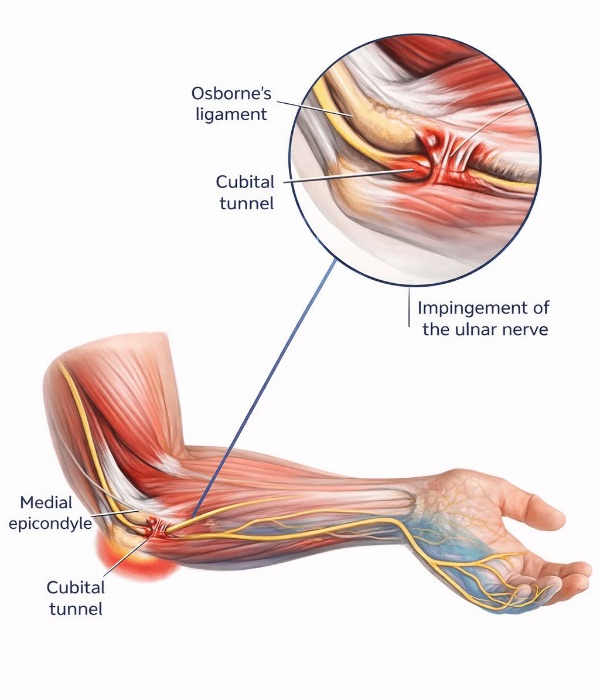
Behind the bump the nerve runs through a narrow passage of bone, ligament and muscle called the cubital tunnel. When you bend your elbow the tunnel tightens and the nerve is stretched. If the nerve is squeezed or stretched for long enough, it stops working properly and you notice tingling, numbness and, in time, weakness. This is cubital tunnel syndrome.
Symptoms
Symptoms usually start gradually and come and go at first. They tend to follow the path of the ulnar nerve into the hand.
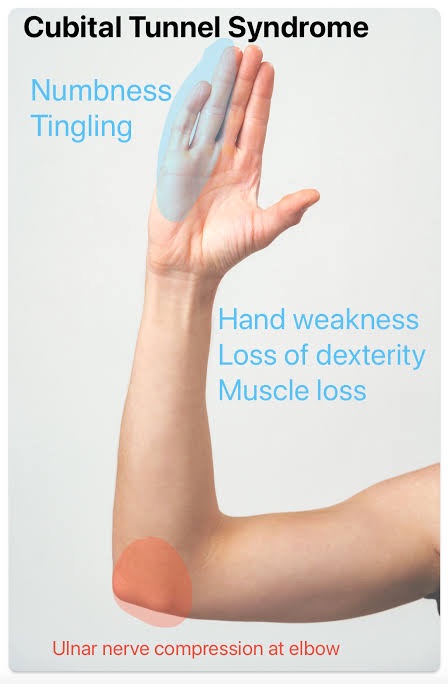
Pins and needles or numbness
In the ring and little fingers, typically worse with the elbow bent, such as when holding a phone, or at night when you sleep with your arms curled up.
Aching at the inner elbow
A dull ache or tenderness on the inner side of the elbow, sometimes spreading down the forearm.
Clumsiness and weak grip
Dropping things, difficulty with buttons or opening jars, and a weaker grip and pinch between thumb and index finger.
Muscle wasting
In longer-standing cases the small hand muscles thin, most visibly in the web space between thumb and index finger. This is a sign to be seen promptly.
What causes it?
Often there is no single cause. Anything that squeezes, stretches or rubs the nerve behind the elbow can contribute.
Prolonged elbow bending
Long phone calls, desk work with the elbows tightly bent, or sleeping with the arms curled up all stretch the nerve for long periods.
Leaning on the elbow
Resting the inner elbow on a desk, armrest or car door presses directly on the nerve where it has little protection.
A nerve that flicks over the bone
In some people the nerve slips forwards over the bony bump each time the elbow bends, which irritates it with repeated movement.
Elbow arthritis and bone spurs
Swelling and bony spurs from a worn elbow joint can narrow the tunnel. Read more in the elbow arthritis guide.
Old fractures
A previous elbow fracture, sometimes from many years earlier, can change the shape of the elbow and gradually stretch the nerve.
Conditions that can feel similar
Tingling in the hand has several possible causes, and more than one can be present at once. Pinpointing where the nerve is affected guides the right treatment.
Carpal tunnel syndrome
Pressure on the median nerve at the wrist. It usually affects the thumb, index and middle fingers rather than the little finger.
Read the carpal tunnel guideGuyon's canal (ulnar nerve at the wrist)
The same ulnar nerve can be squeezed at the wrist. The finger symptoms are similar, but the back of the hand and the elbow are usually spared.
Nerve compression in the neck
A trapped nerve root in the neck can cause tingling in the same fingers, often with neck pain or symptoms that change with neck position.
Read the neck pain guideElbow pain without tingling has other causes too. Pain on the outer elbow is more often tennis elbow, inner elbow pain with gripping can be golfer's elbow (see the tennis elbow and golfer's elbow guide), and stiffness with aching may point to elbow arthritis.
Your assessment
How it is diagnosed
Most of the diagnosis comes from listening carefully and examining the arm. Tests confirm the picture and show how badly the nerve is affected.
-
1
History
Which fingers are affected, what makes it worse, how long it has been going on, and whether you have noticed any weakness or clumsiness.
-
2
Examination
Tapping over the nerve (Tinel's test) and holding the elbow fully bent (the elbow flexion test) to see if they bring on tingling. Froment's sign checks pinch strength, and the nerve is felt to see whether it flicks over the bone.
-
3
Nerve conduction studies
A test that measures how well signals travel along the nerve. It confirms where the nerve is compressed, how severe it is, and helps rule out other causes.
-
4
Imaging when needed
An X-ray can show arthritis, bone spurs or old fractures, and ultrasound can show the nerve itself. Find out more in the imaging and scans guide.
Non-surgical treatment
Mild symptoms, without weakness or wasting, often settle by taking pressure and stretch off the nerve. These measures are simple, but they need to be kept up for several weeks.
The night-time elbow brace
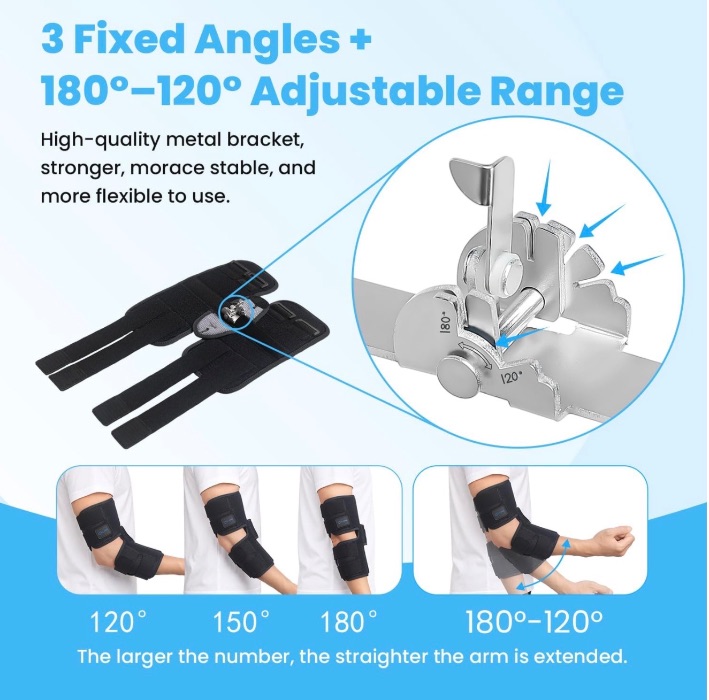
Many people sleep with their arms tightly bent, which stretches the ulnar nerve and squeezes it in the cubital tunnel for hours at a time. That is why tingling is often worst at night or first thing in the morning.
The brace is worn at night to stop the elbow bending sharply while you sleep. Keeping the elbow straighter reduces the stretch and pressure on the nerve and gives it a chance to settle.
It is usually tried for several weeks, alongside avoiding leaning on the elbow and long periods with the elbow bent, such as on the phone or at a desk.
Avoid prolonged bending
Use a headset or speakerphone, adjust your desk so your elbows sit more open, and take regular breaks to straighten your arm.
Keep the elbow straighter at night
A night splint, or simply a towel wrapped loosely around the elbow, stops it bending fully while you sleep, when symptoms are often at their worst.
Padding
An elbow pad, or avoiding leaning on the inner elbow, protects the nerve where it lies just under the skin.
If symptoms persist despite these measures, or there is weakness or wasting in the hand, surgery is usually recommended to protect the nerve.
Surgery
Cubital tunnel release
The aim of surgery is to give the ulnar nerve more room and stop it being squeezed or rubbed. It is done through a cut along the inner side of the elbow.
In-situ decompression
The tight roof of the tunnel is released so the nerve is no longer compressed, leaving it in its normal position. This suits most people with cubital tunnel syndrome and is the simplest operation.
Anterior transposition
In some cases the nerve is released and also moved to the front of the inner elbow bone, where it is no longer stretched as the elbow bends. This is used when the nerve is unstable and flicks over the bone, or in some revision cases. Read more about ulnar nerve transposition below.
On the day
Cubital tunnel release is usually a day case, so you go home the same day. It is done under a general anaesthetic or a regional anaesthetic that numbs the whole arm. Mr Jepson operates at Circle Three Shires Hospital in Northampton and Woodland Hospital in Kettering. See clinic locations for details.
Risks
All surgery carries some risk. Mr Jepson will discuss these with you in detail before you decide.
- Wound problems, such as infection, tenderness or a thickened scar
- A patch of numbness near the scar from small skin nerves
- Symptoms that persist, particularly when the nerve was badly affected before surgery
- Rarely, injury to the ulnar nerve itself
Consent with Concentric
Before any operation, Mr Jepson talks you through the benefits, risks and alternatives. The practice uses Concentric, a secure digital consent system, so you can read about your operation at home, ask questions and record your decision. Consent is confirmed again on the day. Read more in the day of surgery guide.
To see what happens on the day of your operation, from pre-assessment and fasting to the anaesthetic and going home, read the day of surgery guide.
Surgery
Ulnar nerve transposition
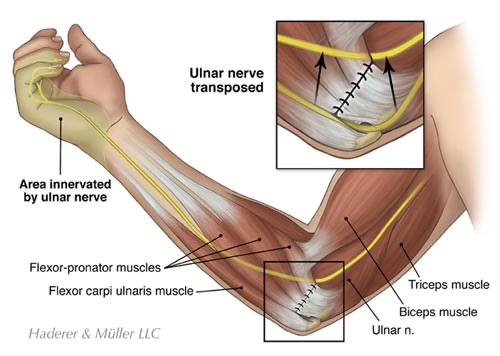
Sometimes releasing the nerve is not enough on its own. In an anterior transposition, the ulnar nerve is released and then moved to a new, more protected position at the front of the inner elbow.
What it is
After the nerve is freed from the cubital tunnel, it is lifted out of its groove behind the medial epicondyle, the bony bump known as the funny bone, and moved to the front of the inner elbow. In its new position it no longer has to stretch around the bump every time you bend your elbow.
Most often the nerve is placed in the fatty tissue just under the skin, called a subcutaneous transposition, and held there with a small sling of soft tissue so it cannot slip back. Occasionally it is placed beneath or within the muscle, called a submuscular transposition.
The operation is done through a longer cut along the inner side of the elbow than a simple release. It is usually a day case under a general anaesthetic or a regional anaesthetic (nerve block) that numbs the arm.
Why it is done
Not everyone needs their nerve moved, and Mr Jepson often performs a simple release first. A transposition is considered when:
The nerve flicks over the bone
If the nerve slips over the epicondyle as the elbow bends (subluxation), it can stay irritated after a simple release.
Symptoms have come back
When symptoms return after an earlier release, moving the nerve may be part of revision surgery.
The tunnel floor is damaged
Scarring, narrowing or an uneven floor from arthritis, bone spurs or an old elbow fracture can keep rubbing the nerve.
The nerve's bed is unhealthy
If the elbow is deformed or the tissue the nerve lies in is unhealthy, a new path can give it a better place to recover.
Mr Jepson will explain at your consultation whether a simple release or a transposition suits you, and why.
What to expect afterwards
- A soft dressing or sling for comfort for a few days
- Gentle elbow movement started early, as advised, to prevent stiffness
- Recovery tends to take a little longer than after a simple release
- Nerve recovery is gradual: numbness often improves before strength, which can take months
Risks
Mr Jepson will go through these with you before you decide.
- A patch of numbness near the scar from a small skin nerve
- Tenderness of the scar
- Infection
- Elbow stiffness
- Symptoms that do not fully resolve
For what happens on the day itself, from arriving at hospital to the anaesthetic and going home, read the day of surgery guide.
Recovery
The wound heals in a couple of weeks, but the nerve takes much longer, whether you have had a simple release or a transposition. Knowing what to expect helps you stay patient as it recovers.
Dressings
Keep the dressing clean and dry. The wound is usually checked at around two weeks, when any stitches are removed.
Early movement
Gentle elbow and finger movement starts soon after surgery to prevent stiffness, avoiding heavy lifting while the wound heals. After a transposition a sling may be used for comfort for a few days.
Hand therapy
A hand therapist can guide exercises, scar care and a safe return to everyday tasks, especially after a transposition.
Gradual nerve recovery
Recovery continues over months, and tends to take a little longer after a transposition. Tingling usually improves first, with strength returning more slowly.
Muscle wasting may not fully recover, even after a successful operation, because nerve and muscle can only heal so far once they have been affected for a long time. That is why severe or worsening symptoms, or any thinning of the hand muscles, are best seen early.
Common questions
General information to help you prepare. Your own advice will be tailored at your consultation.
Send an enquiryIs cubital tunnel surgery painful?
You will not feel the operation itself. Afterwards the elbow is usually sore for a few days, and this is generally well controlled with simple painkillers. The scar can stay tender to lean on for some weeks.
Will I need my nerve moved?
Usually not. Many people do well with a simple release, which leaves the nerve where it is. Moving the nerve is considered when it flicks over the bone as the elbow bends, when symptoms have returned after an earlier release, or when the tunnel is scarred or uneven. Mr Jepson will explain which suits you at your consultation. Read more about ulnar nerve transposition.
When can I drive?
You can drive once you can control the car safely, including an emergency stop, and are comfortable holding the wheel. For most people this is within a couple of weeks, sometimes a little longer after a transposition. It is sensible to check with your motor insurer.
When can I go back to work?
It depends on your job. Desk-based work can often resume within a week or two, while heavy manual work usually takes longer. Mr Jepson will give you a guide based on your work and the type of operation.
Do I need a referral, and will my insurance cover it?
If you are paying for yourself you can usually book directly. If you are insured, check your policy first, as many insurers ask for a GP referral, and get an authorisation number from your insurer before your appointment. The practice team can help with any questions, so get in touch.
Can cubital tunnel syndrome come back?
It is uncommon for symptoms to return after surgery, but it can happen, for example if scar tissue forms around the nerve. Some symptoms may also persist if the nerve was badly affected beforehand. If symptoms come back, further assessment and occasionally revision surgery, which may include a transposition, may be advised.
Related conditions
Other nerve and elbow problems that can cause similar tingling, aching or weakness.
- Carpal tunnel syndrome Tingling in the thumb and first fingers from the median nerve at the wrist. Read the guide
- Tennis elbow and golfer's elbow Tendon pain on the outer or inner elbow, often worse with gripping. Read the guide
- Elbow arthritis and elbow arthroscopy Stiffness, aching and bone spurs in a worn elbow joint. Read the guide
- Neck pain and cervical spine problems Trapped nerves in the neck that cause arm pain and finger tingling. Read the guide
Talk to the practice about your shoulder, elbow, hand or wrist
Call to arrange a consultation, book online for Circle Three Shires Hospital in Northampton, or send a short email and the practice team will come back to you.
Read independent patient reviews on Doctify (opens in a new tab), iWantGreatCare (opens in a new tab) or Google reviews (opens in a new tab)